Complex Systems and Evolutionary Constraints
Protein Function and Sequence Space ended by noting that “local fitness constraints” establish that many specific pathways are blocked without establishing that every pathway everywhere is blocked. This chapter takes up that distinction at the level of whole molecular systems and whole populations: does a demonstrated constraint in one system, or one population, tell us anything about evolution's capacity in general? The two most quantitatively serious challenges to evolutionary capacity — irreducible complexity and waiting-time arguments — are both taken seriously here on their own terms, alongside the strongest evidence and the strongest limits on each.
By the end of this chapter you should be able to:
- state the irreducible-complexity argument in its strongest form, and explain what the V-ATPase case study does and does not establish against it;
- explain the distinction between present dependency and historical origin, with a concrete example;
- work through the Behe–Snoke waiting-time model, Lynch's critique of it, and the Durrett & Schmidt two-mutation analysis, and state what each does and does not establish;
- distinguish mutation load, Muller's ratchet, and mutational meltdown from the young-earth creationist “genetic entropy” argument; and
- explain why a demonstrated local constraint is not the same as a demonstrated universal evolutionary limit.
Core distinction for this chapter: a demonstrated local constraint is not the same as a demonstrated universal evolutionary limit. Every section below asks not just “is this constraint real?” (often yes) but “how far does it generalize?” (usually much less far than a first reading suggests).
Irreducible Complexity
A system can be called irreducibly complex in a purely descriptive sense if it consists of multiple interacting parts, and removing one or more of those parts destroys the system's present core function. Many biological systems meet this descriptive condition, and it is not, by itself, controversial — it is simply an observation about how the modern system currently works.
The controversial step is historical: if the modern system needs all of its present components, could it have evolved through simpler functional precursors? These are not the same claim. The strongest version of the argument runs: if system S requires components A, B, C, and D; removing any one component destroys the system's present function; and natural selection can only preserve steps that provide some selectable benefit; then, if no simpler intermediate configuration is functional, a gradual pathway appears inaccessible. This argument becomes much stronger if one can actually demonstrate that every plausible simpler intermediate is nonfunctional or deleterious — a demanding requirement, not an assumption.
The underlying concern is empirically grounded, not merely rhetorical. Fitness-landscape experiments show that many mutational pathways are blocked and that epistasis can make intermediates harmful, with mutational order strongly affecting which routes remain open Epistatic accessibility of mutational pathways. Some evolutionary routes really are inaccessible from some starting points — the question this chapter pursues is how far that finding generalizes.
Falsification test: the general inference from irreducible complexity — that present indispensability rules out a simpler functional ancestor — would be seriously strengthened if researchers could show, for a specific system, that no simpler functional precursor is even historically plausible: no viable co-option candidate, no duplication-and-specialization route, and no comparative-genomic evidence of a once-simpler ancestral configuration. It would be seriously weakened, as it already has been for V-ATPase below, by direct experimental reconstruction of a viable simpler ancestral pathway.
Present Dependency versus Historical Origin
Suppose a modern system's function requires three parts: A + B + C → function X. Removing B yields A + C → no function X. This proves that B is necessary for the modern system's present function. It does not prove that the ancestor was simply A + C → useless. A possible ancestral history could instead run: A → function Y; A + B → improved Y; A + B + C → function X. Or: A + B → function Y, then duplication produces A + B + B′, then specialization produces A + B + C → function X.
Present-day indispensability does not automatically imply simultaneous historical origin. A component required today does not necessarily have to have existed, in its current indispensable role, when the system first arose — it may have joined later, taking over or refining a role a simpler ancestral configuration performed on its own.
Co-option
Co-option (sometimes called exaptation) is the process by which a component already performing one role in an organism gets recruited into a new system for a different purpose. A protein that originally functioned in one biochemical context can, without necessarily changing its own biochemistry at all, become a required part of a different system simply because that system's other components evolved to depend on it. Co-option is one of the historical routes by which present dependency can arise without simultaneous origin of every part: a part does not need to be invented for the system that currently depends on it.
Duplication and Specialization
A second historical route runs through the mechanism introduced in Gene Duplication: a single ancestral component capable of performing multiple roles is duplicated, and the descendant copies then specialize, each retaining or refining a subset of the ancestral capability. Where co-option recruits an existing, unchanged part into a new system, duplication-and-specialization produces two or more differentiated parts from one generalist ancestor. Both routes offer a way for a modern system to end up needing several distinct, interdependent components without requiring that all of them originated together, from scratch, for their current joint purpose.
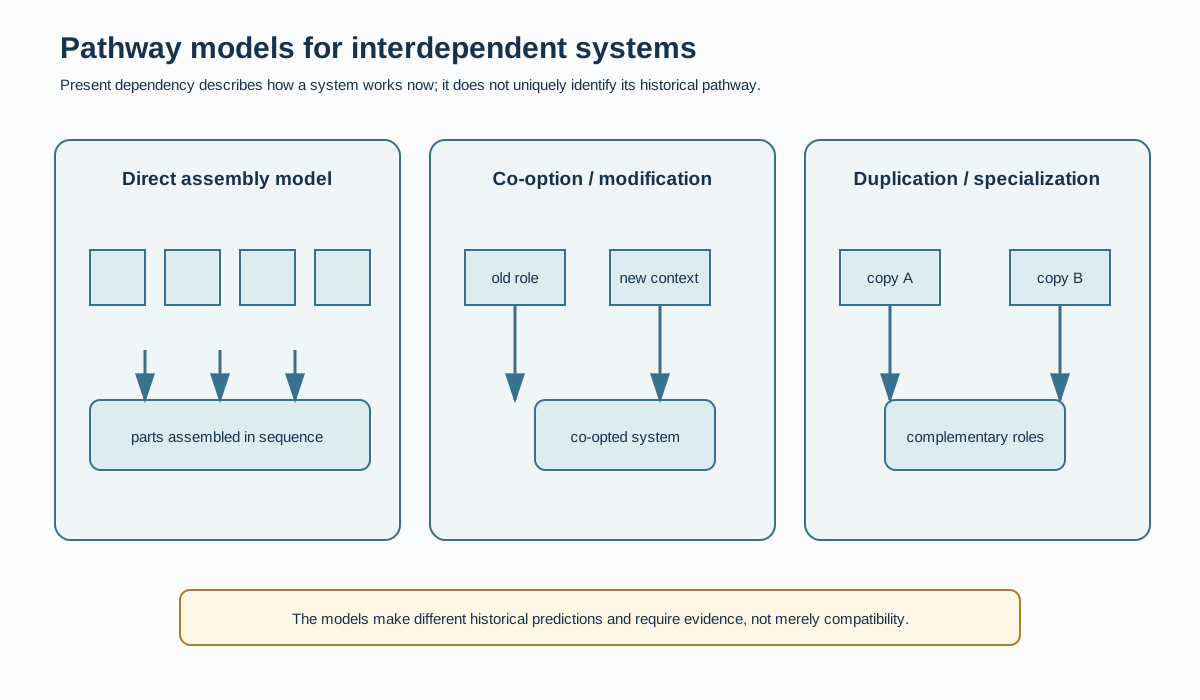
Naming co-option or duplication as possible historical routes is not, by itself, evidence that either route actually occurred in any specific system. Each proposed case still requires its own supporting evidence — homology, comparative genomics, or, as in the case study below, direct experimental reconstruction — not just logical possibility.
V-ATPase Case Study
Finnigan, Hanson-Smith, Stevens, and Thornton investigated the fungal V-ATPase proton pump, a molecular machine whose modern membrane ring contains three differentiated paralogous proteins, descended from a simpler ancestral system with fewer differentiated subunits. The researchers inferred ancestral protein sequences using the ancestral-reconstruction method described in Ancestral Protein Reconstruction, synthesized those ancestral proteins, placed them into living yeast, tested their function, and introduced historical mutations one at a time to study how molecular interactions changed V-ATPase complexity via duplication and complementary loss.
Main result: duplication was followed by complementary loss of interaction capabilities. A single ancestral multifunctional protein duplicated into two copies; one copy lost ability X while the other lost ability Y, and both copies became mutually required for the modern system's function. Introducing the actual historical mutations into the reconstructed ancestral proteins reproduced key parts of this increase in dependency experimentally — this is not a hypothetical scenario but a tested, reconstructed one.
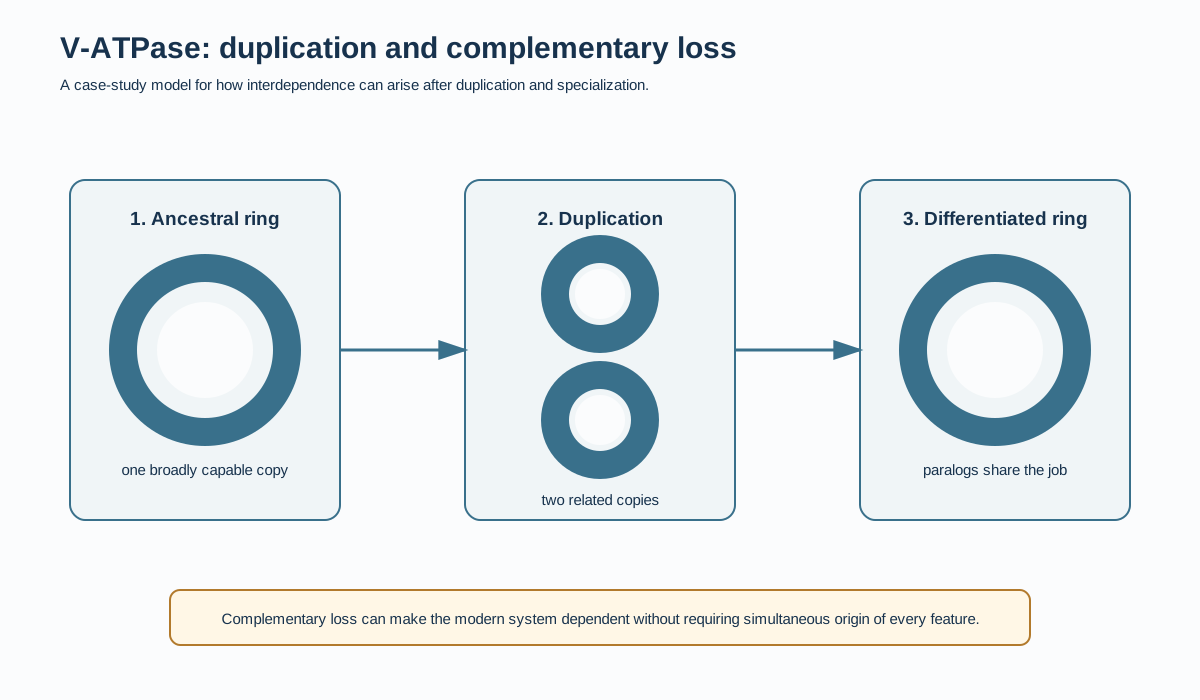
The experiment demonstrates that a present-day multi-component system can become more interdependent over time without all components having to arise simultaneously. A simpler ancestral system functioned first; duplication and specialization later made descendant components individually indispensable. This directly weakens the general inference that if removing a component destroys a modern machine, that machine could never have existed in a simpler ancestral state — at least for this system, that inference is demonstrably false.
The V-ATPase study does not prove that every molecular machine evolved by this same route. It examined one specific system, and the increased complexity it documented resulted primarily from gene duplication, specialization, and complementary loss of interactions — it did not require the evolution of an entirely new biochemical activity from scratch. Ancestral sequence reconstruction, as noted in the previous chapter, remains a historical inference tested experimentally, not direct observation of the ancient organisms themselves.
Increasing Complexity Through Complementary Loss
The V-ATPase result illustrates a genuinely counterintuitive general principle. Suppose one ancestral protein can perform two interactions — binding X and binding Y. After duplication, both copies can still bind X and Y. If complementary losses then occur, so that one copy retains only the ability to bind X and the other retains only the ability to bind Y, both components are now required, where one sufficed before. The system has become more specialized, more interdependent, and more organizationally complex, while each individual protein has, by itself, lost an ancestral capability.
This is why “information” cannot be treated as a single intuitive quantity, a point New Biological Information introduced from a different angle. By one measure, each protein lost function. By another, the system gained differentiated organization. The V-ATPase work experimentally supports this type of process actually occurring, rather than merely being logically conceivable.
Waiting-Time Arguments
A separate and more quantitative family of objections asks not whether a pathway exists in principle, but whether the right combinations of mutations can plausibly arise, persist, and spread within realistic population sizes and realistic amounts of time. A rigorous waiting-time argument has to specify population size, effective population size (which governs the strength of genetic drift relative to selection Brian Charlesworth, Effective population size and patterns of molecular evolution and variation — Nature Reviews Genetics), mutation rate, the number of mutational targets capable of producing the relevant phenotype, whether intermediate states are beneficial, neutral, or deleterious, recombination rate, and generation time. Fixation itself is not guaranteed even for a beneficial mutation: a new beneficial variant can be lost to drift while still rare, with fixation probability depending on the selection coefficient and population structure Patwa & Wahl (2008), The fixation probability of beneficial mutations — Journal of the Royal Society Interface. A waiting-time result is therefore always conditional on the biological model feeding it, not a single universal number.
Behe and Snoke
Michael Behe and David Snoke published a peer-reviewed model examining duplicated genes in which a new protein feature requires multiple specific amino-acid residues before the feature becomes selectable at all. Their model assumed a duplicated gene, point-substitution mutation, a multi-residue feature providing no selective advantage until fully complete, specific required residues, and that the duplicate gene is not lost before the feature appears. Under the parameter ranges they examined, features requiring two or more specified amino-acid changes could require very large populations to fix within 108 generations; the paper concluded that populations on the order of 109 or greater could be required for some modeled features Behe & Snoke, Simulating evolution by gene duplication of protein features that require multiple amino acid residues — Protein Science.
This formalizes a legitimate objection: if an innovation genuinely requires several prescribed changes and no intermediate step is selectable, the waiting time can become severe, even prohibitively long for realistic population sizes.
The model does not establish that all new protein functions require prescribed residues in this way, that no weak intermediate activity ever exists, that duplication is always the relevant starting point, that alternative sequences cannot perform the same function, that recombination, standing variation, regulatory changes, or promiscuous activities (see Enzyme Promiscuity) cannot help, or that all major biological innovations face the same restrictive parameter regime the model assumed.
Michael Lynch argued that the Behe–Snoke conclusions depend strongly on these restrictive biological assumptions, and that evolutionary paths can change substantially if intermediate states have partial activity, mutations alter quantitative rather than all-or-none traits, multiple genetic solutions exist, or redundancy permits intermediate retention Michael Lynch, Simple evolutionary pathways to complex proteins — Protein Science. The dispute illustrates a general principle that recurs throughout this chapter: a waiting-time estimate is only as relevant as the biological assumptions defining the mutational target and its intermediates.
Durrett and Schmidt
Durrett and Schmidt mathematically analyzed the waiting time for two specific mutations to co-occur, with applications to regulatory-sequence evolution. Their results showed that two-step changes can be slow in populations with small effective population sizes, including human-like populations, while occurring much faster in large populations such as Drosophila under comparable assumptions Durrett & Schmidt, Waiting for two mutations: with applications to regulatory sequence evolution and the limits of Darwinian evolution — Genetics.
This is important because it rejects two opposite oversimplifications at once: “two mutations are always easy” and “two mutations are always prohibitively improbable.” Neither is generally correct; the answer depends heavily on effective population size and the specific mutational target, exactly the parameter-sensitivity the Behe–Snoke/Lynch exchange also illustrates.
Simultaneous versus Sequential Mutation Requirements
Whether a required pair of mutations, A and B, is easy or hard to acquire depends heavily on which of several biologically distinct cases applies. If both A and B are individually beneficial, selection can amplify the first intermediate as soon as it appears, making the two-step path much easier than requiring both mutations at once. If A is neutral and only the combination AB is beneficial, A can persist by drift until B occurs, with the waiting time depending on how long neutral A-lineages typically persist. If A is actively deleterious and only AB is beneficial, the population faces a genuine fitness-valley-crossing problem (discussed next). If the intermediate state is rapidly eliminated and no alternative route exists, the process approaches a true simultaneous-mutation requirement and can become much slower still. Recombination offers a further route in sexual populations: two lineages separately carrying A and B alone can combine directly into AB without either lineage needing to acquire both mutations on its own.
A demonstrated difficulty in one of these cases does not automatically transfer to the others. Before concluding that a particular biological innovation faced a severe waiting-time problem, it matters a great deal which of these cases actually describes the innovation in question.
Neutral Intermediates
A mutation does not need to be positively selected at every step to persist in evolutionary history. For a new selectively neutral mutation, fixation is possible through drift alone, and because many neutral mutations arise even though each individual one has a low chance of fixation, these effects can roughly balance so that neutral substitution proceeds at a rate related to the underlying mutation rate. This means a population can carry a neutral intermediate mutation for some time, available to combine with a later mutation into a beneficial pair, without selection needing to see any advantage in the interim.
Neutral intermediates are, however, especially sensitive to genetic drift and can be lost from a population before a later, complementary mutation ever occurs — particularly in small populations. A neutral-intermediate pathway is a real possibility, not a guaranteed rescue for every proposed multi-mutation transition.
Fitness Valleys
A fitness valley exists when an intermediate genotype between a starting point and a target genotype is less fit than the starting point — so that reaching the target requires passing, at least temporarily, through a state selection actively opposes. Weissman, Desai, Fisher, and Feldman modeled how asexual populations cross fitness valleys or plateaus and found that crossing time depends strongly on mutation rate, population size, valley width, and the fitness cost of the intermediate state Weissman, Desai, Fisher & Feldman, The rate at which asexual populations cross fitness valleys — Theoretical Population Biology.
Large populations can sometimes cross broad neutral or shallow valleys through stochastic tunneling, in which the final beneficial genotype appears from within an intermediate lineage before that intermediate lineage ever reaches fixation on its own Weissman, Desai, Fisher & Feldman, The rate at which asexual populations cross fitness valleys — Theoretical Population Biology.
Small populations, or strongly deleterious intermediates, can make the same transition dramatically slower. Fitness valleys are real, quantitative constraints, but their severity is parameter-dependent rather than absolute: valley-crossing theory does not establish that every proposed historical pathway was accessible, and the existence of one difficult valley does not demonstrate that no alternative pathway existed around it.
Genetic Entropy
Young-earth creationist writers, most prominently John Sanford, argue that most new mutations are deleterious, that many have effects too small for selection to remove efficiently, and that genomes should therefore undergo unavoidable long-term deterioration — a claim popularized as genetic entropy. The Mendel's Accountant simulation tool was developed specifically to model this claim Sanford et al., Mendel's Accountant: A New Population Genetics Simulation Tool for Studying Mutation and Natural Selection — International Conference on Creationism proceedings / ICR.
The underlying scientific question genetic entropy raises is legitimate and shared with mainstream population genetics: how effectively can selection and recombination prevent the accumulation of slightly deleterious mutations across long timescales? Where mainstream science and the genetic-entropy argument diverge is over whether the answer to that question is “not very effectively, for essentially all populations, inevitably” — a considerably stronger and more general claim than mainstream population genetics itself supports.
Whether mutation accumulation causes inevitable genomic decline depends on the true distribution of mutational fitness effects, effective population size, recombination, dominance, epistasis, beneficial mutation rates, changing environments, and reproductive excess available for selection to act on. Variants with effects far below the drift threshold may accumulate, while mutations with larger deleterious effects are more efficiently purged. The existence of mutation load (below) does not by itself establish inevitable species-wide degeneration, and showing that purifying selection generally works does not prove that every long-term load problem is negligible in every population.
Falsification test: the general genetic-entropy claim — that all populations, without exception, inevitably deteriorate genetically over time — would be seriously weakened by any well-documented natural population maintaining stable or improving fitness over many generations under measured, realistic mutation rates and selection pressures, which is the typical finding in long-term wild and experimental population studies. It would be seriously strengthened by direct field or laboratory measurement of declining fitness, driven specifically by mutation accumulation rather than environmental change, in large, naturally recombining populations rather than only in engineered small-population conditions or simulation output.
Creationist simulations such as Mendel's Accountant are relevant to how a particular model behaves under its assumed parameters, but simulation output depends entirely on the distributions and parameters fed into it and is not equivalent to direct observation of inevitable long-term decline in real populations.
Mutation Load
Mutation load is the reduction in a population's average fitness caused by the ongoing presence of deleterious mutations, balanced against selection continually removing them — a real, well-established phenomenon in mainstream population-genetic theory, not a claim unique to genetic-entropy arguments. Mainstream population genetics already incorporates mutation load, mutation-selection balance, Muller's ratchet, background selection, and mutational meltdown as established concepts, and treats deleterious mutation accumulation as a real force to be quantified case by case, not dismissed.
Muller's Ratchet
Muller's ratchet describes a specific mechanism by which asexual (or strongly linked, low-recombination) populations can accumulate deleterious mutations irreversibly. In a finite population without recombination, the individuals carrying the fewest deleterious mutations form a distinct class; if that least-loaded class is lost by chance (drift), because recombination cannot reconstruct it from more heavily loaded individuals, the population's minimum mutation load only ever increases, one irreversible click at a time — hence “ratchet.” Recombination is the mainstream mechanism most directly implicated in resisting this process, since it can reconstruct low-load genotypes from separately mutated lineages, which is one reason Recombination is not merely a source of novel combinations but also a defense against irreversible mutational accumulation.
Mutational Meltdown
Mutational meltdown is the extreme endpoint of mutation load and Muller's ratchet: a runaway feedback loop in which declining fitness reduces effective population size, which weakens selection's ability to remove deleterious mutations, which further reduces fitness, and so on toward extinction. Unlike genetic entropy as a general claim about all populations, mutational meltdown has actually been experimentally observed under specific conditions. In laboratory yeast populations engineered with small effective population size and greatly elevated mutation rates, some populations underwent fitness decline and extinction consistent with this process Zeyl, Mutational meltdown in laboratory yeast populations — Evolution.
This establishes that mutation accumulation can genuinely overwhelm selection and drive a population toward collapse under some conditions — it is not merely a theoretical possibility.
The conditions that produced observed mutational meltdown — small effective population size and artificially elevated mutation rate — are specific and, in the yeast experiment, deliberately engineered. This does not establish that mutational meltdown is occurring, or is inevitable, in large, sexually reproducing, naturally recombining populations at natural mutation rates, which is the much broader claim the genetic-entropy argument requires.
Diminishing Returns
As organisms become better adapted to a particular environment, further beneficial mutations tend to provide progressively smaller fitness gains, a pattern documented directly in experimental evolution and generally described as diminishing-returns epistasis Diminishing-returns adaptation. Long-term experimental evolution more broadly confirms that adaptation is cumulative — successful intermediates, once common, become the background later mutations build on — while also documenting epistasis, diminishing returns, clonal interference, inaccessible paths, and historical contingency all operating together Long-term adaptation and historical dynamics.
Diminishing returns within a well-studied experimental lineage does not establish a fixed, universal ceiling on adaptation in general. It shows that the rate of improvement slows as a population approaches a local optimum for its current environment and genetic background — not that no further evolutionary change of any kind remains possible, including change following an environmental shift that resets which traits are advantageous.
Local versus Universal Limits
This closing section makes explicit the question every prior section in this chapter has been implicitly testing. Has a universal mutation or complexity limit been demonstrated? No. Existing experiments and models establish local or system-specific constraints — for example, that only a few mutational pathways connect one state to another in a particular system, under particular assumptions. That does not establish that no biological lineage can ever evolve beyond some universal complexity threshold. Demonstrating a universal evolutionary ceiling would require a general principle showing that all relevant paths beyond the boundary are inaccessible, for every system, not just the specific ones studied here — and no evidence reviewed in this chapter establishes such a universal limit.
The reverse overstatement should also be avoided. Evolutionary biology has likewise not experimentally demonstrated that mutation and selection can generate every imaginable type or level of biological complexity. That claim would equally exceed the evidence presented throughout this chapter and the two preceding it.
Best-supported current conclusion: known evolutionary mechanisms have demonstrated the capacity to generate genuine functional novelty and increased molecular complexity in specific, tested cases — the V-ATPase reconstruction chief among them. At the same time, they have not experimentally reconstructed every proposed major biological innovation, waiting times and fitness valleys are real, parameter-sensitive constraints in specific modeled systems, and no universal upper bound on evolutionary capacity has been experimentally demonstrated on either side of this debate.
Open question: no general method currently exists for calculating, in advance, how many duplication-and-specialization or co-option steps would be required for a given complex system to arise from a plausible simpler ancestor, or for estimating the waiting time such a pathway would require using measured (rather than assumed) intermediate fitness effects. Without that, claims on both sides about whether a specific system's origin was “easy” or “essentially impossible” remain harder to adjudicate than the V-ATPase case study alone can settle.
Key Takeaways
- Irreducible complexity is a real descriptive property of many systems, but present-day indispensability does not, by itself, establish that every component arose simultaneously; co-option and duplication-with-specialization are tested historical alternatives.
- The V-ATPase reconstruction directly demonstrated increased molecular interdependence arising from duplication and complementary loss in one specific system, without requiring any new biochemical activity to appear from nothing.
- Waiting-time models (Behe & Snoke, Lynch's critique, Durrett & Schmidt) show that the severity of a multi-mutation requirement depends heavily on population size, whether intermediates are neutral, deleterious, or beneficial, and whether recombination can combine separately arising mutations — there is no single universal answer.
- Mutation load and Muller's ratchet are established mainstream population-genetic phenomena; mutational meltdown has been directly observed under engineered laboratory conditions, but that is a narrower claim than the young-earth “genetic entropy” argument that all populations inevitably deteriorate.
- No experiment or model reviewed in this guide establishes either a universal evolutionary ceiling or unlimited evolutionary capacity; both overstatements exceed the evidence.
Common Overstatements
- “This system is irreducibly complex, so it could not have evolved.” Present-day indispensability does not establish historical origin; the V-ATPase case study directly demonstrates a tested counterexample pathway (duplication plus complementary loss) for one real system.
- “Behe and Snoke proved evolution is too slow to work.” Their model's conclusions depend on restrictive assumptions (no partial intermediate activity, no alternative genetic solutions) that Lynch showed can change the result substantially when relaxed; the model demonstrates one parameter regime, not a universal speed limit.
- “Mutational meltdown has been observed, so genetic entropy is confirmed.” Observed meltdown required engineered small effective population size and elevated mutation rate in yeast; extrapolating that result to inevitable decline in large, sexually recombining natural populations is a considerably broader claim than the experiment supports.
- “No universal limit has been proven, so evolution can do anything.” The absence of a demonstrated universal ceiling is not evidence for unlimited evolutionary capacity either; that reverse overstatement is addressed explicitly in Local versus Universal Limits above.
Check Your Understanding
Why doesn't the V-ATPase study prove that irreducible complexity, as an argument, is generally wrong?
The V-ATPase study is a positive existence proof for one specific system: it experimentally showed that duplication followed by complementary loss can produce a modern, present-day irreducibly complex system from a simpler, functional ancestral state. That establishes the general inference (“present indispensability means no simpler ancestor could have existed”) is not universally true. It does not establish that every irreducibly complex system arose this same way; each proposed case still needs its own supporting evidence, exactly as the Duplication and Specialization section notes.
A critic argues that Behe and Snoke's model proves evolution cannot produce complex features quickly enough. What is the strongest response, and what does that response not establish?
The strongest response is Lynch's critique: the severe waiting times in the Behe–Snoke model depend on restrictive assumptions, particularly that no intermediate state has any partial function and that no alternative genetic solution exists. Relax those assumptions and the waiting time can drop substantially. This response does not establish that every biological innovation actually had an available partial-function intermediate or alternative solution — it establishes that the Behe–Snoke conclusion is model-dependent, not that every specific historical case was actually easy. Durrett and Schmidt's finding that two-mutation waiting times vary enormously with population size reinforces this: there is no single correct answer independent of the specific parameters.
Why does this chapter treat “mutational meltdown” and “genetic entropy” as related but distinct claims rather than the same thing?
Mutational meltdown is a specific, mainstream population-genetic phenomenon that has been directly observed experimentally, but only under engineered conditions: small effective population size and artificially elevated mutation rate in laboratory yeast. Genetic entropy is a broader young-earth creationist claim that essentially all populations, including large, sexually recombining natural ones at natural mutation rates, are inevitably deteriorating. The experimental evidence directly supports the narrower mutational-meltdown claim under the tested conditions; it does not, by itself, establish the much broader genetic-entropy claim, which depends on parameters (natural mutation-effect distributions, real population sizes, real recombination rates) that the controlled experiment did not test.
What We Know
Irreducible complexity is a real, descriptive property of many present-day molecular systems. Duplication followed by complementary loss has been experimentally reconstructed as a historical route to increased interdependence in at least one system (V-ATPase). Waiting-time severity for multi-mutation requirements depends heavily on population size, effective population size, and whether intermediates are neutral, deleterious, or beneficial. Mutation load and Muller's ratchet are established, mainstream population-genetic phenomena. Mutational meltdown has been directly observed under specific, engineered laboratory conditions.
What Remains Disputed
How often co-option and duplication-with-specialization, as opposed to other or unknown routes, actually explain the historical origin of specific present-day irreducibly complex systems beyond V-ATPase is genuinely open and requires case-by-case evidence. Whether the restrictive Behe–Snoke parameter regime or Lynch's more permissive assumptions better describe any particular historical protein-feature origin is often not independently determinable after the fact. Whether mutation load, in real natural populations with real recombination rates, poses a serious long-term problem approaching genetic-entropy-style predictions, or is adequately checked by purifying selection as mainstream population genetics generally concludes, remains a live and quantitative disagreement, taken up further in Major Counterarguments.
What Would Move the Debate Forward
Additional ancestral-reconstruction case studies, in the direct experimental style of the V-ATPase work, applied to other candidate irreducibly complex systems, would show how far that result generalizes beyond the one system currently tested. Waiting-time models that use measured, rather than assumed, distributions of intermediate-state fitness effects for specific real protein features would narrow the gap between the Behe–Snoke and Lynch positions. Direct measurement of long-term mutation-load trends in large, naturally recombining populations — rather than engineered small-population laboratory conditions or simulation output alone — would most directly address whether genetic-entropy-style concerns generalize beyond the specific conditions under which mutational meltdown has actually been observed.
Sources for This Chapter
- [Primary Research] Epistatic accessibility of mutational pathways
- [Primary Research] V-ATPase complexity via duplication and complementary loss
- [Review / Synthesis] Brian Charlesworth, Effective population size and patterns of molecular evolution and variation — Nature Reviews Genetics
- [Review / Synthesis] Patwa & Wahl (2008), The fixation probability of beneficial mutations — Journal of the Royal Society Interface
- [Primary Theoretical Research / Modeling] Behe & Snoke, Simulating evolution by gene duplication of protein features that require multiple amino acid residues — Protein Science
- [Scholarly Critique / Response] Michael Lynch, Simple evolutionary pathways to complex proteins — Protein Science
- [Primary Theoretical Research / Modeling] Durrett & Schmidt, Waiting for two mutations: with applications to regulatory sequence evolution and the limits of Darwinian evolution — Genetics
- [Primary Theoretical Research / Modeling] Weissman, Desai, Fisher & Feldman, The rate at which asexual populations cross fitness valleys — Theoretical Population Biology
- [Creationist Research Organization] Sanford et al., Mendel's Accountant: A New Population Genetics Simulation Tool for Studying Mutation and Natural Selection — International Conference on Creationism proceedings / ICR
- [Primary Research] Zeyl, Mutational meltdown in laboratory yeast populations — Evolution
- [Primary Research] Diminishing-returns adaptation
- [Primary Research] Long-term adaptation and historical dynamics