Falsifiability and Model Testing
Intelligent Design repeatedly returned to one question: what would count as evidence against a given claim, rather than merely evidence that has not yet been found? This chapter collects that question into one place and applies it systematically to every major claim in this guide. A scientific claim earns its standing partly by specifying, in advance, what observation would count against it. This page is deliberately one of the most important in the guide: a framework that cannot specify its own falsification conditions is harder to evaluate as science, whichever side of a debate it supports.
By the end of this chapter you should be able to:
- state the specific potential falsifier for each of the seven evolutionary claims;
- describe what fossil, genomic, and second-biosphere discoveries would seriously challenge current conclusions;
- state what would falsify a specific Intelligent Design claim, and what would strongly favor ID; and
- explain the difference between falsifying one proposed pathway and falsifying an entire explanatory framework.
Seven-Claim Falsification Table
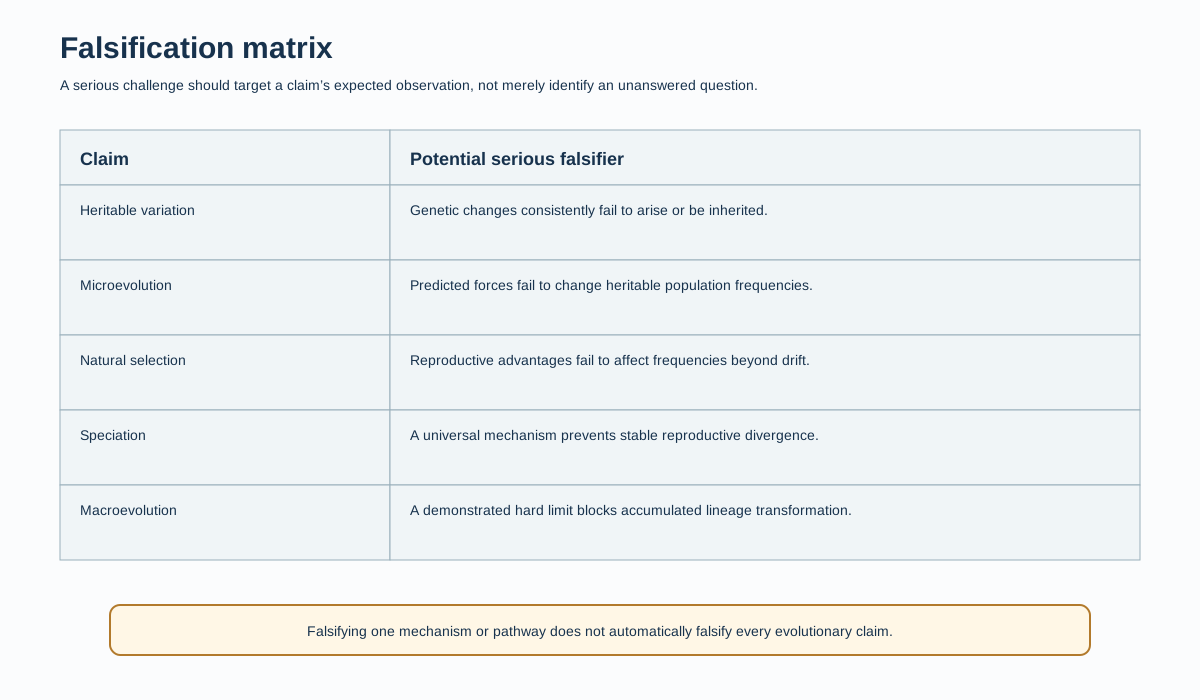
The Seven Evolutionary Claims gave each claim its own “Falsification Test” callout. The table below collects all seven in one place, in the exact form used throughout this guide, so they can be compared side by side.
| Claim | Potential Serious Falsifier |
|---|---|
| Heritable variation | Genetic changes consistently fail to arise or be inherited |
| Microevolution | Heritable population frequencies fail to change despite predicted forces |
| Natural selection | Reproductive advantages fail to affect population frequencies beyond drift |
| Speciation | A universal biological mechanism prevents stable reproductive divergence |
| Macroevolution | A demonstrated hard biological limit prevents accumulated lineage transformation |
| Common descent | Independent datasets repeatedly produce irreconcilable ancestry patterns |
| Universal common descent | Discovery of genuinely independent extant cellular life |
Notice the pattern of increasing specificity toward the bottom of the table. A falsifier for claim 1 (heritable variation) would be a basic, repeatable laboratory failure; a falsifier for claim 7 (universal common descent) requires something considerably rarer — an entire independent biological system. This does not mean the lower claims are weaker; it reflects that broader claims require broader, harder-to-produce disconfirming evidence, not that they are shielded from disconfirmation altogether.
Fossil Falsification Tests
The Fossil Record establishes that fossil preservation is non-random and that missing evidence is not automatically contradictory evidence Sansom, Gabbott & Purnell, Non-random decay of chordate characters causes bias in fossil interpretation — Nature. That distinction matters directly for falsification: an isolated gap or disputed specimen is not, by itself, a serious threat to current geological chronology, because incompleteness is already an expected and quantitatively studied property of the fossil record Foote & Sepkoski, Absolute measures of the completeness of the fossil record — NatureBenton, Wills & Hitchin, Quality of the fossil record through time — Nature.
A genuinely powerful anomaly would require considerably more than one disputed specimen. Examples that would seriously challenge current geological chronology include: repeated modern mammal fossils in demonstrably undisturbed Cambrian strata; consistent radiometric ages grossly incompatible with independently established stratigraphic order Geologic Age: Using Radioactive Decay to Determine Geologic Age — U.S. Geological Survey (current reference)Geologic Timescale, Geologic Dating Techniques, and Numeric Ages — U.S. National Park Service (current reference); fossil assemblages repeatedly occurring in no stable temporal sequence; and systematic failure of independent dating systems to converge under well-controlled geological conditions. One anomalous date can result from geological complications such as mineral contamination or later heating; a reproducible global pattern that contradicts expected chronological ordering would be much more serious, and no such pattern has been documented.
This is also why an unusually rapid radiation, such as the Cambrian, is a genuine research question but not by itself a falsifier: quantitative rate analyses of Cambrian diversification have found elevated but not implausible evolutionary rates compared to later periods Cambrian evolutionary-rate analysis, and nest within a longer Ediacaran–Cambrian interval rather than one instantaneous event Wood et al., Integrated records of environmental change and evolution challenge the Cambrian Explosion — Nature Ecology & Evolution. A falsifying pattern would need to be a chronological contradiction, not merely an episode of comparatively fast change.
Genomic Falsification Tests
Common Descent rests most heavily on nested, historically contingent genomic patterns — chromosome fusion signatures, shared endogenous retroviral insertions at corresponding genomic positions, and broad phylogenetic agreement among independent conserved-gene datasets Human chromosome 2 fusion sitePrimate endogenous retroviral insertion patternsConserved proteins across domains. Because that evidence is nested and convergent by construction, its falsifier is correspondingly specific.
Common descent (within well-studied groups) would be seriously weakened by systematic, non-random contradictions between independent nested-similarity datasets — for example, chromosome structure, endogenous retroviral insertions, and gene trees repeatedly pointing to genuinely incompatible relationships that could not be explained by known complicating processes such as incomplete lineage sorting, hybridization, or convergence. The occasional, statistically expected discordance that is actually observed — such as the roughly 30% of the gorilla genome that locally groups gorilla with either humans or chimpanzees instead of following the dominant species tree Gorilla genome and incomplete lineage sorting, or measured insertion-site homoplasy on the order of 0.5% in primate LINE insertions LINE insertion-site homoplasy in primates — falls well short of this: it is exactly the pattern population genetics predicts, not a systematic contradiction of it.
Universal common descent has an additional, more specific genomic falsifier discussed in its own section below.
Second-Biosphere Test
Universal common descent's falsifier in the table above — discovery of genuinely independent extant cellular life — deserves fuller treatment on its own, because it is conceptually different from the other falsifiers in this chapter: it is not a pattern found within the data already being studied, but the discovery of an entirely separate dataset.
Universal Common Descent explains that the strongest evidence for the claim is deep molecular similarity shared across all presently known cellular life: DNA as hereditary material, RNA intermediates, ribosomes, a broadly shared genetic code, ATP-based energy chemistry, homologous proteins, and overlapping metabolic pathways. A rigorous statistical comparison of universal-common-ancestry models against separate-ancestry models, using universally conserved proteins, favored common ancestry overwhelmingly under the tested models Theobald statistical test of universal common ancestry.
If a genuinely independent form of terrestrial cellular life were discovered — a “second biosphere” using a fundamentally different genetic system, a different or absent DNA/RNA chemistry, a substantially different or absent genetic code, or metabolism built on chemistry unrelated to the ATP-based system shared by every presently known organism — that would directly falsify the claim that all presently known cellular life shares one common ancestor, since it would demonstrate that at least one lineage of cellular life arose independently of the others.
A second biosphere finding would not, by itself, undo the evidence for common descent among already-studied organisms — humans and other apes would still share chromosome 2's fusion signature and their nested retroviral insertions regardless of what is discovered elsewhere. It would specifically falsify the “universal” scope of the claim: that literally all known life traces to one lineage. As Universal Common Descent already notes, universal common descent cannot easily detect extinct independent origins from billions of years ago even if they occurred, since only lineages that left descendants would be represented today — the second-biosphere test can only ever confirm or falsify claims about presently extant independent life, not about how many origins of life occurred historically.
No genuinely independent terrestrial biosphere has been documented; proposed “shadow biosphere” hypotheses remain speculative searches rather than confirmed findings. The test's value lies in being a clearly specified, in-principle discovery that would count decisively against the claim — exactly the kind of advance specification a falsifiable claim should have.
ID Falsification Tests
Intelligent Design already introduced this material; it is repeated and extended here because falsifiability is this page's central subject. ID must be formulated specifically enough to be falsifiable. Consider a specific claim: molecular system M could not evolve because every simpler intermediate is nonfunctional.
That specific claim would be strongly undermined or falsified if researchers reconstructed a plausible ancestral system, identified functional intermediates, generated the transition experimentally through realistic mutations, and showed the pathway was accessible at plausible population sizes and timescales. This would not falsify the existence of a designer in a general or philosophical sense — it would falsify only the narrower empirical claim that system M specifically required intelligent intervention.
A version of ID formulated as “the designer chose to make everything look exactly as if evolution occurred” is essentially impossible to falsify by any observation, because it can be made retroactively consistent with any result. That unfalsifiability is precisely what greatly reduces its scientific explanatory value; it is a difference in kind from the specific, testable claim above, not merely a difference in how confident one should be in it.
The reverse question — what would strongly favor ID, rather than merely fail to falsify it — requires several conditions simultaneously: a biological feature contains a large amount of independently quantified functional information; the ancestral starting state is well established; realistic evolutionary pathways are quantitatively inaccessible within the available population sizes and time; the feature appears without a plausible ancestral genomic precursor; horizontal transfer and known natural mechanisms are excluded; the organization exhibits a signature independently associated with intelligence; and the design model makes additional predictions that are later confirmed. Meeting only one or two of these conditions — for example, an unresolved origin combined with subjective engineering resemblance — falls short of what would make the case scientifically strong, for the same reason that “not yet explained” falls short of “positively supported” throughout this guide.
Falsifying a Pathway versus Falsifying a Framework
A recurring reasoning error, on every side of this debate, is treating a challenge to one proposed historical pathway as if it were a challenge to the entire explanatory framework that pathway sits inside. This distinction runs through several of the guide's “Major Logical Boundaries” and is worth stating explicitly as a falsification principle in its own right.
| What is actually shown | What it does not automatically show |
|---|---|
| A fossil gap exists for a particular transition | Macroevolution generally is false — an incomplete record is expected, not contradictory, evidence |
| One transitional fossil is found | The entire evolutionary tree is proven — one fossil supports one relationship, not every branch |
| Two gene trees disagree at one node | Common descent is disproven — discordance can arise from incomplete lineage sorting, hybridization, HGT, or duplication/loss, and is only damaging if it systematically exceeds those quantitative expectations |
| Theobald's specific statistical test of universal common ancestry was methodologically challenged Critique of Theobald's universal-common-ancestry test | Universal common ancestry itself has been disproven — a critique of one proof is not evidence against the underlying claim, and the broader comparative-genomic case remained strong even in the critics' own assessment Analysis of formal tests of universal common ancestry |
| A specific proposed evolutionary pathway for one molecular system (for example, the earliest flagellar motor) has not been fully reconstructed | Common descent, natural selection, or evolutionary theory generally has failed — an unresolved pathway for one system does not falsify the mechanisms already directly observed elsewhere |
| A specific ID claim about one molecular system (for example, that system M's intermediates are all nonfunctional) is falsified by a reconstructed pathway | Intelligent Design as a general position has been disproven — the narrower claim about system M is falsified, not the broader philosophical claim that a designer exists |
The general principle: falsifying evidence should be evaluated at the same level of generality as the claim it is offered against. A pathway-level failure (this specific route from A to B has not been demonstrated) legitimately weakens confidence in that specific route and should prompt looking for a better one; it does not, by itself, constitute evidence against the framework-level claim (some route from A to B, or something like A to B, exists) unless the pathway-level failures become systematic, repeated across independent attempts, and accompanied by a positive case that no accessible route exists at all — the kind of quantitative exclusion described in Predictive Expectations and in Complexity and Limits.
Key Takeaways
- Every claim in this guide has a specified, in-principle falsifier — broader claims require correspondingly broader and rarer disconfirming evidence, not immunity from disconfirmation.
- An isolated fossil gap or one disputed specimen is not a serious chronological falsifier; a reproducible, systematic pattern contradicting expected order would be.
- The second-biosphere test is the clearest falsifier for universal common descent specifically, and is conceptually distinct from genomic tests of common descent among already-studied organisms.
- ID becomes falsifiable exactly to the extent that its claims are formulated narrowly (about a specific system) rather than as an unfalsifiable claim that a designer made everything look exactly like unguided evolution.
- The single most common reasoning error across this whole debate is treating a pathway-level challenge as if it were a framework-level falsification, in either direction.
Common Overstatements
- “This fossil gap disproves macroevolution.” An incomplete record is the expected, already-quantified state of the fossil record, not contradictory evidence; see the fossil falsification tests above for what would actually be damaging.
- “One gene tree disagrees with the species tree, so common descent is false.” Bounded, quantitatively expected gene-tree discordance is compatible with common descent; only systematic, unexplained contradiction across independent datasets would seriously weaken the claim.
- “No second biosphere has been found, so universal common descent is proven beyond question.” Failing to falsify a claim is not the same as positively proving it; the absence of a second biosphere is consistent with universal common descent but does not, by itself, rule out every alternative explanation for the observed molecular similarity.
- “ID cannot be falsified, so no version of it is scientific.” The unfalsifiable “designer made it look exactly like evolution” formulation is a genuine problem, but narrower, system-specific ID claims (like the flagellum example above) are falsifiable in principle, even when they have not yet been falsified in practice.
Check Your Understanding
Why does universal common descent require a rarer, more specific falsifier (a second biosphere) than macroevolution does (a demonstrated hard biological limit)?
Because the two claims are supported by different kinds and depths of evidence, and a falsifier has to be capable of actually undermining the specific evidence in question. Macroevolution's evidence is a pattern within one interconnected biological history (fossils, anatomy, genetics, chronology), so a hard limit demonstrated within that history could challenge it. Universal common descent's evidence is that every presently known example of cellular life shares deep molecular machinery; the only observation that would directly contradict “every known example” is finding an example that does not share it — which requires discovering an entirely independent biological system, not finding a new pattern within the already-known ones.
A critic points out that a particular molecular pathway for the earliest ATP synthase has not been fully reconstructed. Does this falsify universal common descent or evolutionary theory generally?
No, and this is a direct example of the pathway-versus-framework distinction. An unreconstructed pathway for one specific ancient molecular system is a genuine, legitimate open question about that system's history. It is not, by itself, evidence against the much broader claims (universal common descent, natural selection, common descent among well-studied groups) that rest on separate, independently strong evidence. Treating every unresolved pathway as a framework-level falsifier would make nearly every historical science unfalsifiable in practice, since some specific reconstruction is nearly always incomplete somewhere.
Why is “the designer made everything look exactly like it evolved” considered scientifically weaker than a specific claim like “system M's intermediates are all nonfunctional”?
Because the first claim can be made consistent with literally any observation after the fact — there is no possible finding that would count against it, since any evidence for evolution can simply be reinterpreted as the designer's chosen appearance. The second claim specifies, in advance, exactly what discovery (a functional intermediate, an accessible mutational pathway at realistic population sizes) would count against it. A claim that specifies its own falsification conditions can be tested and potentially overturned by evidence; a claim that cannot be stated this way cannot be meaningfully tested by any observation, regardless of how the underlying philosophical question is ultimately resolved.
What We Know
Every major claim addressed in this guide has a specific, statable falsifier, ranging from a basic laboratory failure to reproduce heritable variation, to the discovery of a genuinely independent form of extant cellular life. None of these falsifiers has been observed to date. Specific ID claims about individual molecular systems are falsifiable in principle by reconstructing accessible evolutionary pathways; only the maximally unfalsifiable formulation of ID (a designer who made everything look exactly like unguided evolution) escapes this kind of testing, and does so at a direct cost to its scientific standing.
What Remains Disputed
How much pathway-level uncertainty in any specific historical reconstruction should be allowed to accumulate before it becomes framework-level evidence is a genuine point of disagreement rather than a settled threshold; reasonable, informed observers can disagree about exactly when a pattern of unresolved specific cases becomes a systematic problem for the broader claim. Whether any presently proposed ID design signature meets the bar of “independently validated” rather than “defined from the case it explains” also remains disputed between ID proponents and mainstream critics.
What Would Move the Debate Forward
For the seven-claim table: continued monitoring of large-scale sequencing, field, and laboratory-evolution studies for any systematic failure matching one of the stated falsifiers, none of which has occurred to date. For fossil chronology: any reproducible, independently dated anomaly of the kind described above, subjected to the same cross-checking standards already applied to the existing record. For universal common descent: continued astrobiological and microbiological search for genuinely independent biochemistry, and statistical methods for testing common ancestry that are demonstrably robust to the alignment-correlation critique raised against Theobald's original test. For ID: a prospectively validated design signature, tested on cases not used to construct it, would be the clearest way to move a specific ID claim from “not yet falsified” to “positively supported.”
Sources for This Chapter
- [Primary Research] Sansom, Gabbott & Purnell, Non-random decay of chordate characters causes bias in fossil interpretation — Nature
- [Primary Research] Foote & Sepkoski, Absolute measures of the completeness of the fossil record — Nature
- [Primary Research] Benton, Wills & Hitchin, Quality of the fossil record through time — Nature
- [Scientific Organization] Geologic Age: Using Radioactive Decay to Determine Geologic Age — U.S. Geological Survey (current reference)
- [Scientific Organization] Geologic Timescale, Geologic Dating Techniques, and Numeric Ages — U.S. National Park Service (current reference)
- [Primary Research] Cambrian evolutionary-rate analysis
- [Review / Synthesis] Wood et al., Integrated records of environmental change and evolution challenge the Cambrian Explosion — Nature Ecology & Evolution
- [Primary Research] Human chromosome 2 fusion site
- [Primary Research] Primate endogenous retroviral insertion patterns
- [Primary Research] Conserved proteins across domains
- [Primary Research] Gorilla genome and incomplete lineage sorting
- [Primary Research] LINE insertion-site homoplasy in primates
- [Methods / Conceptual] Theobald statistical test of universal common ancestry
- [Scholarly Critique / Response] Critique of Theobald's universal-common-ancestry test
- [Methods / Conceptual] Analysis of formal tests of universal common ancestry