Foundations: Concepts and Scientific Method
Introduction and Orientation laid out this guide's scope and its central editorial rule: define a claim, present the strongest evidence for and against it, state what each side does and does not establish, and describe what would falsify it. This chapter supplies the vocabulary and reasoning tools that rule requires — the mechanisms evolutionary biology actually proposes, and the distinctions needed to read historical and experimental evidence carefully. Everything from the seven claims onward assumes the concepts introduced here.
By the end of this chapter you should be able to:
- name the mechanisms modern evolutionary theory proposes, beyond natural selection alone;
- explain why microevolution, macroevolution, common descent, and universal common descent are separate claims, not synonyms;
- distinguish direct observation from historical reconstruction, and evidence from proof; and
- explain what it would mean for an evolutionary claim to be falsifiable.
Darwin versus Modern Evolutionary Theory
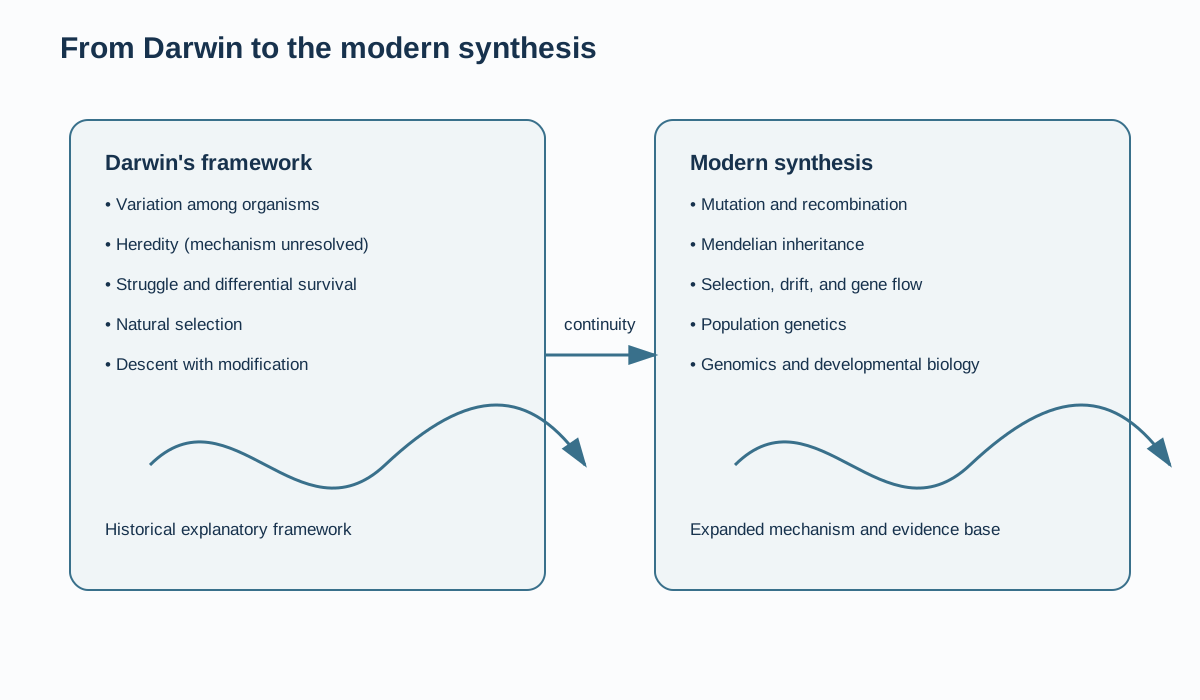
Charles Darwin's On the Origin of Species (1859) rested on two central ideas. Common descent held that living species are historically related, with present organisms descending with modification from earlier organisms. Natural selection held that organisms vary, some of that variation affects survival or reproduction, and advantageous heritable variations tend to become more common over generations. Darwin supported both ideas with evidence from variation in nature, selective breeding, biogeography, fossils, comparative anatomy, and adaptation.
Darwin did not, however, know the molecular mechanism of heredity. He had no knowledge of DNA, chromosomes as hereditary structures, Mendelian genetics, or mutation as it is understood today. His model reduces to: variation, plus inheritance, plus differential reproduction, produces biological change over generations.
During the twentieth century, Darwinian natural selection was combined with Mendelian genetics into the Modern Synthesis, and modern evolutionary biology has continued to expand well past that point. Recognized mechanisms now include mutation, recombination, natural selection, genetic drift, gene flow, sexual selection, horizontal gene transfer, gene duplication, and genome rearrangement. Modern evolutionary theory is therefore not simply “Darwin's theory” carried forward unchanged: Darwin supplied foundational ideas, especially natural selection and common descent, but the theory itself has changed substantially since 1859.
Mutation
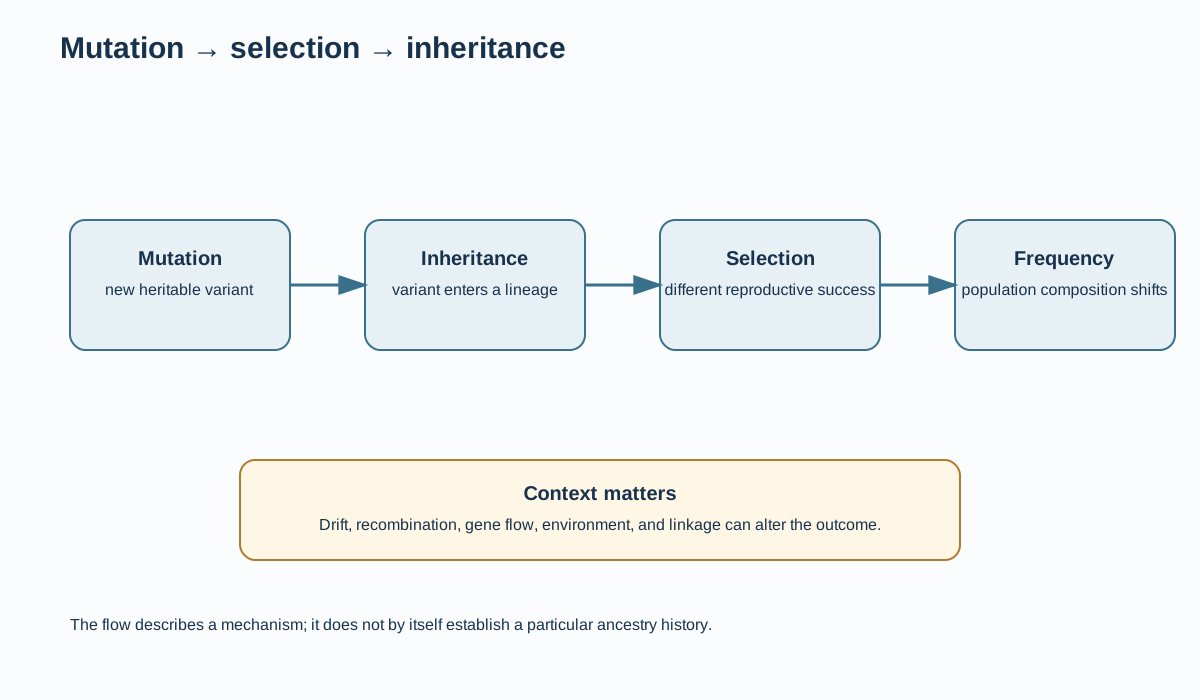
A mutation is a change to an organism's DNA sequence. Mutations are the ultimate source of new genetic variants; without them, a population's genetic variation would only be reshuffled, never expanded. Modern sequencing lets researchers observe mutation and inheritance directly rather than infer it indirectly: sequence parents, sequence their offspring, identify variants absent from the parents, and, across further generations, watch some of those new variants get inherited.
A four-generation pedigree study using multiple sequencing technologies estimated roughly 98–206 new mutations of different types (single-nucleotide changes, insertions and deletions, repeat-length changes, and structural variants) arising per transmission from parent to child Four-generation pedigree mutation study. A large Icelandic study sequencing 1,548 parent-offspring trios identified more than 100,000 de novo mutations and demonstrated that mutation rates rise with parental age, especially paternal age Icelandic de novo mutation study. Because this variation is measured directly at the molecular level, it is among the most directly observable claims in the entire guide.
Inheritance
Inheritance is the transmission of genetic material, and the traits it influences, from parent to offspring. A mutation only matters evolutionarily if it can be inherited; a mutation confined to a single somatic cell in one individual is invisible to natural selection acting across generations. The pedigree-sequencing studies cited above demonstrate inheritance directly: a subset of the new variants identified in one generation reappear, as expected, in the sequenced genomes of the next.
It is important not to equate genetic inheritance with the full explanation of an organism's observed traits. Phenotype — an organism's observable characteristics — is not simply read off its genotype. Environment, developmental noise, epigenetic state, nutrition, and genotype-by-environment interaction all shape phenotype as well. Experiments in Drosophila have documented substantial phenotypic variation even among individuals with the same genotype raised in the same controlled environment Phenotypic variation in Drosophila. This does not mean genes are unimportant or that inheritance is unreal; it means genetic inheritance is one input into phenotype, not the whole story.
Natural Selection
Natural selection operates when inherited differences affect reproductive success. In evolutionary biology, fitness means approximately reproductive success in a particular environment — not strength, size, or health in any general sense. The strongest cases connect genotype to phenotype to differential survival or reproduction to a measurably changed allele frequency.
A field experiment released 3,000 genetically mixed young sticklebacks into a natural stream; after selection acted, 77 of 126 candidate genetic loci shifted toward the stream-associated variant, significantly more than expected from neutral markers alone Stickleback selection experiment. Genomic work on Darwin's finches connected variation in beak size to a region containing the gene HMGA2 and tracked allele-frequency changes during episodes of drought-driven and competition-driven selection Darwin's finches, HMGA2 and beak size.
Natural selection does not explain every evolutionary change, and modern evolutionary biology does not claim that it does. Long-term study of Darwin's finches has shown that the direction of selection itself can reverse as climate, food availability, and competition change Reversing selection in Darwin's finches, and experiments in bacteria show that whether a given allele spreads can depend on selection, pleiotropy (one gene affecting multiple traits), chance, and genetic background all at once Selection, pleiotropy and chance in bacterial evolution. The evidence against a selection-explains-everything view refutes that overly strong claim; it does not show that selection is not a real, demonstrated mechanism. Organisms can carry neutral traits, maladaptive traits, historical remnants, and trade-offs alongside adaptive ones.
Genetic Drift
Genetic drift is random change in allele frequency from one generation to the next, driven by chance rather than by any fitness difference. It matters most in small populations, where chance sampling has a larger relative effect. Experimental work has directly observed neutral drift producing both genetic and phenotypic variation with no selective advantage involved Experimental neutral drift and phenotypic variation.
Drift does not undermine the existence of natural selection; it shows that several evolutionary mechanisms operate simultaneously, and that not every change in a population's genetic makeup needs an adaptive explanation. Distinguishing drift from selection in any particular case is often difficult and is one of the genuinely open questions in specific evolutionary studies.
Recombination
Recombination reshuffles existing genetic variants rather than creating new ones. During sexual reproduction, chromosome segments from each parent can exchange material, so offspring inherit new combinations of already-existing variants rather than an unaltered copy of either parent's chromosome. Recombination is a major reason full siblings are genetically distinct from one another and from either parent, even though no new mutation is required to produce that distinctness.
Gene Flow
Gene flow is the movement of genetic variants between populations, usually through migration and interbreeding. It tends to homogenize allele frequencies between populations that exchange members, working in the opposite direction from the forces (selection, drift, and geographic isolation) that push populations apart. Later chapters return to gene flow as a genuinely complicating factor: for example, some named species continue to exchange genes at low but measurable rates without fully merging back together, which shows that reproductive isolation is often a continuum rather than an absolute wall.
Gene Duplication
Gene duplication creates an extra copy of a stretch of DNA, including an entire gene. A duplicate copy is free from some of the selective constraint on the original, since the original copy can go on performing its function; the duplicate is then available to accumulate changes and, sometimes, to take on a new or refined function.
In Richard Lenski's long-term E. coli evolution experiment, one population evolved the ability to use citrate as an energy source under aerobic conditions, something the ancestral strain could not do. Genomic analysis traced the key step to a tandem duplication that placed an already-existing citrate transporter gene under a promoter active under aerobic conditions; earlier mutations had changed the genetic background in ways that made this innovation accessible, after which further evolution refined the new trait Genomic basis of citrate utilization in E. coli. The gene itself was not newly invented from scratch; duplication and regulatory change repurposed something that already existed. That distinction — between altering how an existing gene is used and inventing an entirely novel one — matters a great deal for the debates covered in Biological Information.
Horizontal Gene Transfer
Horizontal (or lateral) gene transfer moves genetic material between organisms outside of parent-to-offspring inheritance — especially important among microorganisms, which can exchange genes across what look like separate lineages. Documentation of extensive lateral gene transfer among prokaryotes is substantial Lateral gene transfer in prokaryotic evolution, and some researchers have argued that a strictly branching, tree-shaped history may describe only a small fraction of microbial genome histories, an argument sometimes summarized as the “tree of one percent” Tree of one percent critique.
Horizontal gene transfer strongly challenges the simplified picture in which every gene in every organism follows one single, clean branching tree; early evolutionary history may have been considerably more network-like than that picture suggests. It does not, by itself, mean organisms lack common ancestry: a population of ancestral organisms could share descent, exchange genes extensively, and still produce different histories for different genes. Common Descent and Universal Common Descent return to this distinction in depth.
Common Descent
Common descent is the claim that different species share ancestral populations — broader than speciation, but narrower than the claim that all life shares one ancestor. Similarity alone is weak evidence for it, because similar function can independently produce similar structure. Stronger evidence comes from nested, inherited historical features that are unlikely to be explained by function alone.
Humans have one chromosome that corresponds, end to end, to two separate chromosomes in other great apes. If two ancestral chromosomes fused, researchers would expect to find internal telomere-like sequences at the fusion point and remnants of a second, now-inactive centromere — and both have been found on human chromosome 2 Human chromosome 2 fusion site Degenerate ancestral centromere on human chromosome 2. Humans and other primates also share large numbers of endogenous retroviral insertions — DNA left behind by ancient retroviral infections — at corresponding genomic positions, following the branching pattern expected from primate ancestry Primate endogenous retroviral insertion patterns. Common Descent examines this evidence, and the strongest objections to it, in full.
Universal Common Descent
Universal common descent is the broadest ancestry claim in the guide: that all presently known cellular organisms ultimately trace their genetic heritage to a common ancestral population, often referred to as LUCA (the Last Universal Common Ancestor). LUCA does not necessarily mean the first life, a single individual cell, or the only origin of life that ever occurred — it refers only to the most recent shared ancestral population inferable from the genetic evidence available today.
The strongest evidence is deep molecular similarity across all three domains of cellular life — Bacteria, Archaea, and Eukarya — including DNA as hereditary material, a broadly shared genetic code, ribosomes, and homologous proteins. A comparative analysis of 23 conserved proteins across 45 organisms recovered a broad phylogenetic signal linking the major domains Conserved proteins across domains. This is the broadest and most historically deep claim in the guide, and it is treated on its own in the seven claims chapter alongside its strongest scientific challenges.
Microevolution versus Macroevolution
Microevolution is genetic change within a population across generations — the kind of allele-frequency shift directly measured in, for example, Lenski's long-term E. coli experiment across tens of thousands of generations Genome evolution in the long-term E. coli experiment. Macroevolution refers to the accumulation of change, speciation, and extinction over geological time that produces the large differences seen among more distantly related lineages — the kind of change proposed, for example, in the fish-to-tetrapod and terrestrial-mammal-to-whale transitions.
The relationship between the two is genuinely debated in its details. Mainstream evolutionary biology treats macroevolution as, in large part, the extended accumulation of microevolutionary processes plus speciation and extinction over much longer timescales; no one can observe millions of years directly, so macroevolutionary claims are reconstructed historically from fossils, comparative anatomy, geological chronology, and genetics rather than watched in real time the way microevolution can be. A central question raised by critics — addressed directly in Major Counterarguments — is how much extrapolation from short-term, small-scale experimental evolution to geological-scale change is actually justified. That is a substantive question about scope, not a dispute over whether microevolution itself occurs.
Evolution versus Abiogenesis
As introduced on the home page, biological evolution and abiogenesis are different questions answered by different evidence. Evolution concerns change and diversification once heritable, reproducing systems already exist. Abiogenesis concerns how such systems could have arisen from nonliving chemistry in the first place. A failure to explain abiogenesis would not automatically disprove biological evolution; demonstrating evolution does not, in turn, demonstrate any particular origin-of-life model. This guide keeps them in separate chapters, with Abiogenesis explicitly presented as a less developed, more uncertain topic than the evolutionary chapters that precede it.
Direct Observation versus Historical Reconstruction
Some of the claims in this guide can be watched happening: pedigree sequencing observes new mutations and their inheritance directly, in real time, in living organisms Four-generation pedigree mutation study. Other claims describe events that happened once, deep in the past, and cannot be re-run or watched: no one observed the fish-to-tetrapod transition occur. Historical claims are instead reconstructed by fitting many independent lines of evidence — fossils, comparative anatomy, geological chronology, genetics, and biogeography — into the most coherent explanation available.
This is not a weakness unique to evolutionary biology; it is how every historical science works, including geology, cosmology, and archaeology. A useful worked example of separating what is actually observed from what is inferred about it:
Observation: A fossil lineage shows long-term morphological stasis — it looks much the same across a long span of rock layers.
Mainstream interpretation: Stabilizing selection, environmental tracking, or a pattern of long stasis punctuated by comparatively rapid change (punctuated equilibrium).
Creationist interpretation: Evidence of a fundamental limit on how much large-scale transformation can occur.
What the observation itself establishes: Long-term morphological stability occurred in that lineage. The observation alone does not uniquely identify which broader causal model is correct — that requires additional evidence beyond the stasis pattern itself.
Historical reconstruction is still constrained by evidence: a proposed history has to fit chronology, morphology, genetics, geography, and phylogenetic relationships all at once. Missing data does not license any imaginable story, but multiple stories can sometimes remain compatible with the same observation, which is exactly why this guide separates “what was observed” from “what that observation is interpreted to mean” throughout.
Evidence versus Proof
Empirical science accumulates evidence; it does not generally produce logical proof in the sense mathematics does. A well-supported scientific claim is one that best explains the available evidence and has survived repeated, serious attempts to find evidence against it — not one that has been shown to be true beyond any conceivable revision.
This distinction cuts in both directions, and this guide tries to apply it symmetrically. “Not disproven” is not the same as “positively supported” for any model discussed here, mainstream or dissenting. A single transitional fossil supports a particular relationship or transition; it does not prove that an entire proposed evolutionary tree is correct. A single fossil gap does not prove that no intermediate ever existed. A model that has not been refuted has cleared a much lower bar than a model with active, convergent, positive evidence behind it.
Falsifiability
A claim is falsifiable if some conceivable observation would count as evidence against it. Falsifiability is a demand for the claim to have real content: a claim compatible with literally any possible observation says less than it appears to.
Evolutionary theory contains multiple linked claims of different scope, so falsification has to be asked at the right level. Evidence that weakens a narrow, specific pathway claim (for example, a proposed direct-ancestor relationship for one fossil) does not automatically falsify a broader framework claim (for example, common descent in general) if other independent evidence for the broader claim still holds. Conversely, some observations would be seriously damaging at the framework level: the discovery of a genuine, securely dated modern mammal fossil embedded in undisturbed Cambrian-age rock, for instance, would be far more damaging to the mainstream evolutionary timeline than simply failing to find an expected intermediate fossil, because it would contradict the chronological ordering the whole framework predicts, not merely leave a gap in it. Falsifiability and Model Testing works through this claim-by-claim, including the tests that would seriously challenge Intelligent Design models.
Model Comparison
Rather than asking whether a single model is “true” in isolation, much of modern evidence evaluation asks how well competing models explain the same data relative to one another. A revealing example: rather than simply assuming that sequence similarity across life implies shared ancestry, one analysis built explicit statistical models comparing universal common ancestry against separate-ancestry alternatives and asked which model the data favored; under the tested models, universal common ancestry was favored overwhelmingly Theobald statistical test of universal common ancestry. That specific method was then challenged on methodological grounds — critics argued the statistical approach could be biased toward finding common ancestry by correlations already built into how coding sequences align Critique of Theobald's universal-common-ancestry test, prompting a direct response Theobald response to methodological critique and further independent analysis Analysis of formal tests of universal common ancestry. That exchange is itself a useful model of how model comparison is supposed to work: a specific method gets tested, criticized, and refined, without that process by itself proving or disproving the underlying hypothesis it was built to evaluate. The seven claims chapter covers that specific debate, and what it does and does not show, in full.
Limits of Inference
Every inference drawn from evidence in this guide has a boundary, and stating that boundary explicitly is part of the guide's core method (this is exactly what the “What This Does Not Prove” boxes throughout the guide are for). A few recurring boundaries are worth naming up front:
- Capacity versus frequency. Showing that a mechanism can produce an outcome under specific conditions does not show how often it does so in nature, or that it explains every instance of a similar-looking outcome.
- Local constraint versus universal limit. A constraint demonstrated in one organism, environment, or trait cannot automatically be generalized into a ceiling on evolutionary change everywhere.
- Present dependency versus historical origin. Showing that a system needs all of its current parts to work today does not, by itself, show how that system arose historically; earlier versions of the system may have used different parts for different purposes.
- One case versus the whole picture. A single transitional fossil, a single duplicated gene, or a single statistical test result supports a specific, narrow conclusion — not the entire framework it is cited in support of.
These boundaries apply symmetrically. They limit how far mainstream evolutionary claims can be pushed from a given piece of evidence, and they equally limit how far a critique of that evidence can be pushed against the broader framework it is aimed at.
Key Takeaways
- Modern evolutionary theory is Darwin's core ideas (common descent, natural selection) plus mutation, drift, gene flow, recombination, gene duplication, and horizontal gene transfer.
- Microevolution, macroevolution, common descent, and universal common descent are claims of increasing scope and increasing inferential distance — not synonyms for one another.
- Direct observation and historical reconstruction are both legitimate forms of evidence, but they carry different kinds of uncertainty and should not be conflated.
- “Evidence for” and “proof of” are not the same thing, for any model discussed in this guide.
- A claim is only as meaningful as the observations that would count against it.
Common Overstatements
- “Evolution is just a theory.” Conflates the colloquial sense of “theory” (a guess) with the scientific sense (a well-tested explanatory framework). It also ignores that “evolution” names several claims with very different levels of support, not one monolithic idea.
- “Mutation and selection have been observed, so the entire evolutionary tree of life is proven.” Directly observing microevolutionary mechanisms establishes that those mechanisms are real; it does not, by itself, establish every specific historical relationship claimed across the tree of life.
- “A fossil gap disproves macroevolution.” An incomplete historical record is not equivalent to contradictory evidence; fossilization is rare, and gaps are expected under any model of a genuinely historical, sampled fossil record.
Check Your Understanding
Why does this guide treat microevolution and macroevolution as separate claims rather than as the same idea at different scales?
Because they carry different kinds of evidence and different levels of certainty. Microevolution — allele-frequency change within a population — is directly observed in the lab and field, as in Lenski's long-term E. coli experiment. Macroevolution describes accumulated change over geological time and cannot be watched directly; it is reconstructed from fossils, comparative anatomy, chronology, and genetics. Treating them as identical would let evidence for the directly observed claim silently stand in for evidence about the much more inferential one.
What is the difference between showing that a mechanism can produce an outcome and showing how often it does so?
This is the capacity-versus-frequency distinction described under “Limits of Inference.” Demonstrating that gene duplication, for example, can produce a new regulatory pattern in one documented case establishes capacity. It does not, by itself, establish how often duplication-and-divergence explains the origin of specific complex features across the history of life — that is a separate, harder question that needs its own evidence, taken up directly in Protein Evolution and Complexity and Evolutionary Limits.
Does horizontal gene transfer mean organisms lack common ancestry?
Not by itself. Horizontal gene transfer strongly challenges the simplified picture in which every gene in every organism follows one single, clean branching tree — early evolutionary history may have been considerably more network-like. But a population of ancestral organisms could share descent, exchange genes extensively, and still produce different histories for different individual genes. Evidence that complicates a simple model is not automatically evidence against the broader claim the model was built to describe.
What We Know
The mechanisms named in this chapter — mutation, inheritance, natural selection, drift, recombination, gene flow, gene duplication, and horizontal gene transfer — are each independently, directly documented. The logical distinctions drawn here (mechanism versus ancestry, microevolution versus macroevolution, evidence versus proof, capacity versus frequency) are not merely rhetorical; they track real differences in what has actually been shown by the evidence discussed throughout this guide.
What Remains Disputed
How much weight historical inference should carry relative to direct observation, in any specific case, is a genuine and recurring point of disagreement between mainstream researchers and their critics. So is the capacity-versus-frequency question for particular mechanisms: knowing that gene duplication can produce a new regulatory pattern, for example, does not by itself settle how often duplication-and-divergence explains the origin of specific complex features, a question Protein Evolution and Complexity and Evolutionary Limits take up directly.
What Would Move the Debate Forward
Clearer, claim-specific falsification criteria — stated in advance, for each of the seven claims individually rather than for “evolution” as an undifferentiated whole — would make disagreements easier to resolve. Falsifiability and Model Testing attempts exactly that. Quantitative, model-comparison-style tests (of the kind discussed above for universal common ancestry) that make their assumptions explicit, rather than qualitative appeals to similarity or to gaps, would also narrow the range of genuinely disputed territory.
Sources for This Chapter
- [Primary Research] Four-generation pedigree mutation study
- [Primary Research] Icelandic de novo mutation study
- [Primary Research] Phenotypic variation in Drosophila
- [Primary Research] Stickleback selection experiment
- [Primary Research] Darwin's finches, HMGA2 and beak size
- [Primary Research] Reversing selection in Darwin's finches
- [Primary Research] Selection, pleiotropy and chance in bacterial evolution
- [Primary Research] Experimental neutral drift and phenotypic variation
- [Primary Research] Genomic basis of citrate utilization in E. coli
- [Primary Research] Lateral gene transfer in prokaryotic evolution
- [Review / Synthesis] Tree of one percent critique
- [Primary Research] Human chromosome 2 fusion site
- [Primary Research] Degenerate ancestral centromere on human chromosome 2
- [Primary Research] Primate endogenous retroviral insertion patterns
- [Primary Research] Conserved proteins across domains
- [Primary Research] Genome evolution in the long-term E. coli experiment
- [Methods / Conceptual] Theobald statistical test of universal common ancestry
- [Scholarly Critique / Response] Critique of Theobald's universal-common-ancestry test
- [Scholarly Critique / Response] Theobald response to methodological critique
- [Methods / Conceptual] Analysis of formal tests of universal common ancestry