Intelligent Design as a Competing Explanation
Major Counterarguments surveyed the strongest dissenting arguments against evolutionary claims. This chapter examines the most developed alternative explanatory framework that some of those arguments feed into: Intelligent Design (ID). ID is treated here as a scientific and philosophical claim to be evaluated on its own terms — neither dismissed by definition nor assumed to be correct.
By the end of this chapter you should be able to:
- state the minimal ID hypothesis and distinguish it from young-earth creationism;
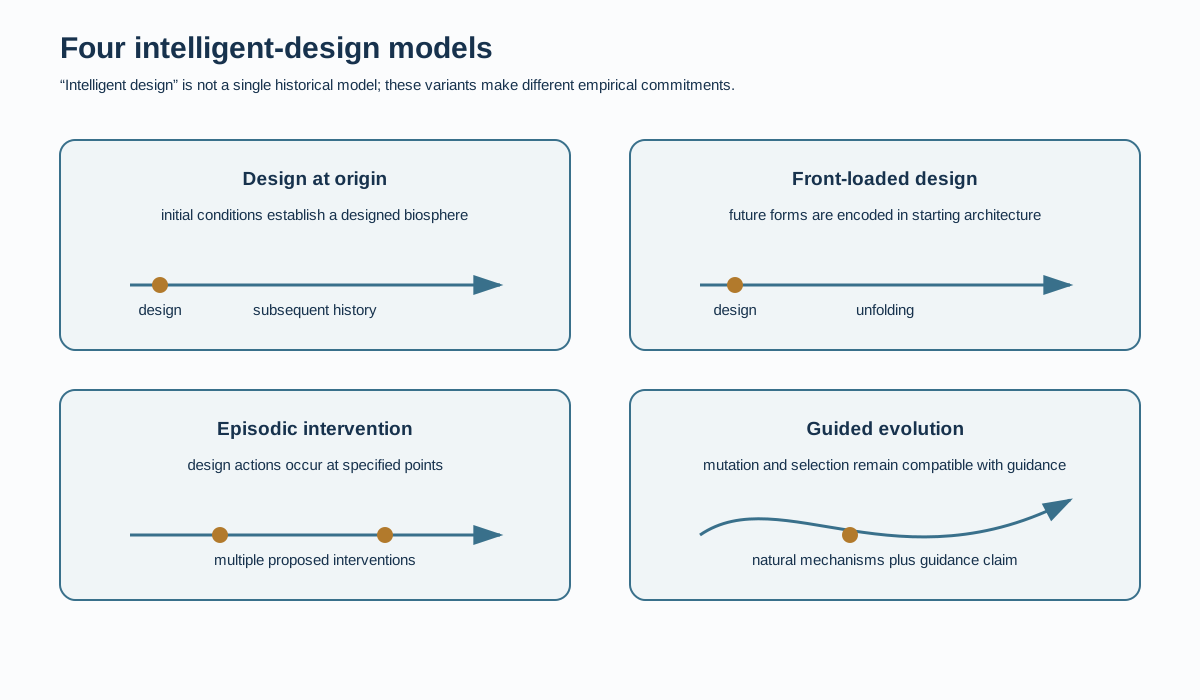
- describe four distinct ID models and how each relates to mutation, selection, and common descent;
- explain specified complexity and irreducible complexity, and what each does and does not establish;
- explain why “evolution cannot currently explain X” is not, by itself, evidence for design;
- describe what a scientifically strong, positive ID research program would require; and
- summarize the comparative evidence for eight frequently discussed biological systems.
Minimal ID Hypothesis
Stripped to its scientific core, Intelligent Design proposes that at one or more points in biological history, an intelligent cause contributed arrangements of matter or genetic information that would have been unlikely or inaccessible through the undirected biological mechanisms otherwise operating at the time Michael Behe on common descent and design. This minimal formulation does not, by itself, require a young Earth, rejection of mutation, rejection of natural selection, rejection of speciation, rejection of common descent, or identification of the designer with any particular religious tradition. Some ID proponents accept common descent while questioning whether mutation, selection, drift, recombination, and related processes are sufficient to explain every major biological innovation Michael Behe on common descent and design.
ID versus Creationism
ID and young-earth creationism are frequently conflated in popular discussion, but they are distinct positions that can be evaluated separately.
- Young-earth creationism typically holds that the universe and life are a few thousand years old, that most present biological diversity descends from originally created “kinds” rather than from one universal common ancestor, and that a global flood explains much of the geological record. It rests on a specific reading of scriptural chronology as much as on biological argument.
- Old-earth creationism and progressive creation accept standard geological and cosmological timescales while proposing periodic direct creative acts across that history.
- Intelligent Design, as formulated by its more scientifically oriented proponents, deliberately avoids committing to Earth's age, the mechanism of intervention, or the identity of the designer. As discussed below, some prominent ID proponents accept full common descent, including human descent from non-human ancestors, while disputing only whether unguided mechanisms are sufficient to explain particular transitions Michael Behe on common descent and design.
Treating ID as simply a rebranding of young-earth creationism understates real differences among these positions, particularly on the age of the universe and the reality of common descent. Conversely, treating ID as entirely free of theological motivation understates its history and the commitments of many of its proponents. Both distinctions matter for accurately representing the range of dissenting views (see build spec §26 on avoiding straw-man treatment).
Design-at-Origin Model
Under Model A, a designer establishes an initial living system, or an unusually information-rich starting condition, after which ordinary evolutionary processes dominate biological history:
DESIGN
  ↓
first sophisticated replicator
  ↓
mutation + selection + drift
  ↓
diversification
Under this model, common descent, fossil succession, endogenous retroviruses and chromosome fusions as evidence of ancestry, and natural speciation could all remain true; most evolutionary history could proceed without further intervention. This model overlaps strongly with origin-of-life questions and is discussed further in Abiogenesis.
Front-Loaded Design
Under Model B, a designer creates early organisms with built-in developmental and genetic capacities that later become expressed through natural evolutionary processes:
designed ancestral genome
       ↓
latent regulatory and developmental potential
       ↓
mutation / recombination / environmental change
       ↓
new phenotypes become accessible
Potentially relevant observations might include modular developmental networks, reusable protein domains, gene duplication, recombination, developmental plasticity, mutation-rate control, and genetic redundancy. However, ordinary evolutionary theory also proposes mechanisms by which modularity and evolvability themselves can evolve. Because of that, the mere existence of evolvability does not, by itself, distinguish front-loaded design from unguided evolution — both models predict it.
Episodic Design Intervention
Model C proposes that intelligent input occurred at particular points during evolutionary history, when ordinary processes reached what the model calls an accessibility limit:
ancestral organism
      ↓
ordinary evolutionary change
      ↓
evolutionary accessibility limit
      ↓
INTELLIGENT INPUT
      ↓
new genes / regulatory architecture / molecular system
      ↓
further ordinary evolution
Possible introduced features might include a new protein-coding gene, new regulatory architecture, several coordinated mutations, a new molecular machine, or developmental information associated with a new body plan. This model is especially relevant to ID arguments about the Cambrian radiation, large bursts of biological novelty, irreducible complexity, and specified complexity Discovery Institute treatment of the Cambrian radiation. Rapid fossil appearance is evidence for design only if design predicts the observed pattern better than natural alternatives such as incomplete preservation, ecological opportunity, developmental innovation, environmental change, rapid adaptive radiation, or threshold effects — a comparison Fossil Record and Falsifiability discuss further.
Guided Evolution
Model D proposes that a designer could influence outcomes while biological evolution continues to operate through its ordinary mechanisms:
mutation
mutation
selected mutation
recombination
selection
guided mutation
selection
From the outside, guided evolution could look identical to ordinary evolutionary history. Its major scientific challenge is therefore detectability: unless guided events produced a statistically distinctive signature, investigators would simply observe them as ordinary mutations. This is the weakest model to evaluate scientifically precisely because it makes the fewest distinguishing predictions.
Compatibility with Mutation and Selection
ID does not need to reject mutation, inheritance, or natural selection. A design-compatible model could run: design → heritable biological system → mutation and recombination → variation, with selection then acting as a real optimization mechanism on that variation. Observed mutation and selection therefore do not falsify ID. At the same time, mutation, inheritance, and selection are already well explained without invoking design, so ID adds little explanatory power at these levels unless variation exhibits properties that natural mechanisms cannot plausibly produce.
Because ID can be made compatible with claims 1–4 from The Seven Evolutionary Claims (heritable variation, microevolution, natural selection, and speciation), observing those processes neither establishes nor falsifies a broad ID model. The genuine dispute concentrates on claim 5, macroevolution: how far unguided mechanisms can proceed without additional input.
Compatibility with Common Descent
Intelligent Design and common descent can coexist. Under a design-then-descent model, endogenous retroviruses, pseudogenes, chromosome rearrangements, neutral substitutions, and shared synteny could all still represent genuine evidence of ancestry; the design question would concern how certain innovations arose, not whether genealogical descent occurred at all. Michael Behe, among the most prominent contemporary ID proponents, accepts broad common descent, including human descent from non-human ancestors Michael Behe on common descent and design. This is a real and consequential difference from young-earth creationist models that reject common descent outright, and it is why treating “ID” and “rejects common descent” as synonymous mischaracterizes a significant strand of ID thought.
Common-Design Model
A related but distinct alternative interprets biological similarity as reuse by a designer rather than inheritance from a shared ancestor — analogous to a software engineer reusing an authentication library, a database library, and a networking library across otherwise unrelated systems. Biologically, a designer might reuse DNA, ATP, ribosomes, protein domains, and developmental genes across unrelated lineages.
This can naturally explain functional similarity: any two organisms that need to metabolize energy might share ATP chemistry regardless of ancestry. It is less obviously explanatory for repeated, historically contingent details that carry no apparent functional requirement — the same broken gene, the same neutral mutation, the same retroviral insertion, the same chromosome rearrangement, the same surrounding genomic organization. Common ancestry gives those specific patterns a direct historical explanation (see Common Descent). A common-design model can still accommodate them, but it must additionally explain why apparently neutral or damaged historical details were repeatedly reused rather than simply not included at all.
Specified Complexity
Specified complexity is one of the concepts ID advocates use to argue that certain biological systems provide positive evidence of design, not merely an absence of evolutionary explanation. The underlying intuition: a sequence or structure is only good evidence of design if it is both complex (improbable under a simple chance process) and independently specified (matches a pattern identifiable apart from the sequence itself, such as a functional requirement) Specified complexity and testability.
As a concept, specified complexity captures something real: a long sequence that happens to spell a coherent English sentence is a qualitatively different kind of evidence than an equally long, equally improbable string of random letters. Applied to biology, the argument is that some genetic sequences or molecular systems are both highly improbable under chance-based models and independently specified by the functional requirements they satisfy.
The central difficulty is calibration. Improbability under a naive uniform-random model is not the same as improbability under the actual evolutionary process, which is not a uniform random search (see Protein Evolution). Quantifying “specification” independently of already knowing the biological outcome, and showing that realistic evolutionary search cannot plausibly reach the specified target, are both necessary and both difficult — see §48 below for what a rigorous version of this argument would require.
Irreducible Complexity
Michael Behe's irreducible complexity argument holds that some biological systems are composed of multiple, well-matched, interacting parts such that removing any one component causes the system to stop functioning. The claim is that such a system could not have evolved through a series of successive, slight modifications, because no functional simpler precursor exists.
As a description of present-day systems, irreducible complexity is often accurate: many molecular machines do lose function entirely when a component is removed today. This is a real, testable empirical claim about the modern system's current dependency structure.
Present-day irreducibility does not, by itself, establish historical inaccessibility. Complexity and Limits covers the general distinction between present dependency and historical origin in more depth: components that are individually essential today can have arrived through co-option, gene duplication, and loss of earlier independent functions, becoming mutually dependent only after the fact. The eight case studies below examine how well this general evolutionary response holds up for specific systems central to the irreducible-complexity literature.
Possible Design Signatures
A hypothetical strong case for design would involve a newly discovered genomic region that has no detectable ancestral precursor, no plausible duplication source, and cannot be explained by horizontal transfer; contains many independently required functional elements that appear essentially simultaneously; encodes a deeply integrated molecular system; and exhibits organization strongly associated with intentional encoding. An even stronger hypothetical case would involve an unmistakably symbolic signal — for example, if DNA encoded a mathematically sophisticated sequence through an arbitrary but unambiguous symbolic convention. Such a signal would carry properties independently associated with symbolic intelligence, rather than properties that could equally well be produced by an undirected process.
No presently known biological system fully meets this description; the point of the hypothetical is to specify, in advance, what would count as strong evidence rather than evaluating candidates after the fact.
Biological Engineering as an Analogy
Humans already provide a known example of intelligent agents modifying genomes: humans can synthesize DNA, edit genes, design proteins, redirect metabolic pathways, and introduce synthetic regulatory circuits. Intelligent causation is therefore not inherently impossible to investigate scientifically. If an unknown intelligent agent had engineered an organism in the deep past, that would in principle be a historical scientific question: researchers could in principle search for evidence distinguishing engineered modification from natural evolutionary history.
The challenge for biological ID is that this analogy is easiest to apply when the designer, mechanism, and approximate timing are already known — exactly the conditions modern genetic-engineering forensics has and present-day ID claims about deep biological history do not. Identifying a reliable diagnostic signature is substantially harder when the designer is unknown, the intervention mechanism is unspecified, and the intervention time is unknown.
Argument-from-Ignorance Problem
Suppose scientists cannot currently explain the origin of some biological system X. That establishes only that the origin of X is unresolved under current models. It does not automatically establish that X was intelligently designed: low confidence in the probability of X given the current evolutionary model does not, by itself, imply a high probability of X given a design model, unless the design model has independent supporting evidence Scientific criticism of argument-from-ignorance reasoning in ID. This is the classic argument-from-ignorance concern.
The identical mistake can run in the opposite direction: “scientists do not yet know how X evolved, therefore evolution must have produced it” is equally unjustified. Lack of a current explanation does not prove either model. The neutral conclusion in an unresolved case is simply: origin presently unresolved — not a silent default to either design or unguided evolution.
Positive Design Theory
For ID to avoid functioning only as a placeholder for current gaps in evolutionary explanation (a “god of the gaps” pattern), it would need a positive theory of intelligent causation with a structure roughly like this: hypothesize that intelligent biological interventions produce some measurable signature S; independently calibrate that hypothesis by studying known engineered biological systems and determining whether S reliably distinguishes them from naturally evolved systems; predict that unknown biological systems of intelligent origin should contain S; search genomes or molecular systems for S; and compare the probability of S given intelligent intervention against the probability of S given mutation, selection, drift, recombination, and horizontal gene transfer. This would transform the dispute into an empirical model-comparison problem rather than a philosophical one.
Predictive Expectations
A rigorous ID research program would, at minimum: quantify the required function precisely (not “system M is complicated” but “system M requires properties X, Y, and Z above measurable functional thresholds”); identify the likely ancestral molecular or genomic state before the innovation appeared; identify plausible evolutionary pathways involving mutation, recombination, duplication, gene loss, regulatory change, co-option, and neutral intermediates; measure accessibility using realistic mutation rates, effective population sizes, generation times, selection coefficients, recombination rates, duplication rates, and valley-crossing probabilities; and demonstrate that natural search is quantitatively inadequate under those realistic parameters — considerably stronger than simply asserting that a system is highly complex. It would then derive an independent design prediction (for example, that designed biological information should appear as coordinated multi-locus novelty without an ancestral mutational trajectory) and test that prediction on new cases not used to construct it. A successful ID theory would ideally predict previously unknown biological features that are later discovered, moving ID beyond criticism of existing evolutionary explanations and toward a positive causal framework Specified complexity and testability.
Testability and Falsifiability
Mainstream scientific institutions argue that present-day ID does not yet meet this bar: the U.S. National Academies has stated that Intelligent Design is not presently a scientific explanation because it does not provide the kind of empirically testable causal account expected in science — a well-specified mechanism, a timing model, and an independently validated design signature National Academies evolution resources. ID proponents dispute this characterization and argue that design can be tested through specified complexity, biological information, irreducible complexity, fossil patterns, and the limits of evolutionary search Specified complexity and testability.
ID must be formulated specifically enough to be falsifiable. Suppose a specific claim is that molecular system M could not evolve because every simpler intermediate is nonfunctional. That claim would be strongly undermined if researchers reconstructed a plausible ancestral system, identified functional intermediates, generated the transition experimentally through realistic mutations, and showed the pathway was accessible at plausible population sizes and timescales. Undermining that narrower claim would not falsify the existence of a designer in general — it would falsify only the specific claim that system M required intelligent intervention.
A version of ID that instead claims the designer chose to make everything look exactly as if evolution occurred is essentially impossible to falsify by any observation, which greatly reduces its scientific explanatory value. The build spec's fuller falsifiability treatment, including what would specifically favor ID, appears in Falsifiability and Model Testing.
A particularly strong empirical design inference would require several conditions simultaneously: a biological feature contains a large amount of independently quantified functional information; the ancestral starting state is well established; realistic evolutionary pathways are quantitatively inaccessible within the available population sizes and time; the feature appears without a plausible ancestral genomic precursor; horizontal transfer and known natural mechanisms are excluded; the organization exhibits a signature independently associated with intelligence; and the design model makes additional predictions that are later confirmed. At that point, design would be more than a placeholder for an unexplained phenomenon.
Comparative Case Studies
The following eight systems are the ones most frequently discussed in the ID literature. Each case study separates the biological system itself, the strongest ID argument specific to that system, the strongest evolutionary evidence, what remains unresolved or not experimentally replayed, and a neutral assessment. These case studies test narrower biological claims — “this system could not arise through known evolutionary mechanisms” — not whether an intelligent creator exists in a philosophical or theological sense.
One system sometimes discussed alongside these — the origin of the genetic code itself — is deliberately not included here as a completed case study. Its earliest history precedes the last universal common ancestor and overlaps directly with unresolved origin-of-life questions; it is addressed, with appropriate limits, in Abiogenesis rather than presented here as settled either way.
Bacterial Flagellum
System. A rotary motility apparatus whose components can include a filament, hook, basal body, export apparatus, rotor/stator proteins, and assembly and regulatory proteins; different bacteria possess different flagellar complements and architectures.
Strongest ID argument. Michael Behe and other ID proponents argue the flagellum is irreducibly complex: removing essential components of the modern motor causes motility to fail Behe & Meyer, Irreducible complexity, bacterial flagellum and the Type III Secretory System — Discovery Institute. A stronger version of the argument asks whether the historical pathway contains too many necessary-but-unselected steps, and correctly cautions against simply assuming that the type III secretion system is the direct ancestor of the flagellum rather than a relative whose direction of derivation must be established phylogenetically.
Strongest evolutionary evidence. Flagellar and non-flagellar type III secretion components share substantial homology, indicating a common evolutionary relationship even if one modern system is not the direct precursor of the other; Pallen and Matzke review homologous components, gene duplication, protein recruitment, modularity, and variation among bacterial flagella Pallen & Matzke, From The Origin of Species to the origin of bacterial flagella — Nature Reviews Microbiology. Liu and Ochman used comparative genomics across bacterial genomes to infer a stepwise history of flagellar gene families and a deeply conserved core Liu & Ochman, Stepwise formation of the bacterial flagellar system — PNAS.
What remains unresolved. There is no directly observed, mutation-by-mutation reconstruction of the first flagellum. The earliest stages occurred deep in bacterial history, where horizontal gene transfer, gene loss, and extensive divergence can obscure the sequence of events; a homology map gives historical relationships among parts without automatically establishing the fitness of every intermediate assembly.
Neutral assessment. The flagellum is not well represented by the claim that no relevant simpler homologous systems or component histories exist. At the same time, the complete origin of the earliest rotary flagellar system has not been experimentally replayed from a pre-flagellar ancestor. The specific claim that no functional intermediate is possible would be substantially weakened by demonstrating a viable series of simpler ancestral systems with realistic selective benefits; the evolutionary account would be weakened if detailed comparative genomics repeatedly showed the core components appearing together without ancestral homologs and quantitative pathway analysis excluded realistic routes.
Vertebrate Blood-Clotting Cascade
System. Vertebrate coagulation converts circulating precursor proteins into an insoluble fibrin clot through regulated proteolytic cascades, including the tissue-factor pathway, contact/intrinsic pathway, prothrombin/thrombin, fibrinogen/fibrin, and numerous regulatory proteins.
Strongest ID argument. Behe's argument focuses on a proposed functional core of the clot-forming system rather than requiring every mammalian factor to be indispensable; his concern is that a functional cascade must simultaneously activate clotting, prevent inappropriate clotting, localize the response, and terminate it appropriately Michael Behe, In Defense of the Irreducibility of the Blood Clotting Cascade — Discovery Institute. This is a stronger claim than asserting that every mammalian factor is required, since some factors are demonstrably absent from other vertebrates.
Strongest evolutionary evidence. The vertebrate clotting system is not invariant: lamprey studies identified factor VII, factor X, prothrombin, and protein-C-like genes while failing to find several later mammalian contact-pathway components Kimura, Ikeo & Nonaka, Evolutionary origin of vertebrate blood complement and coagulation systems inferred from liver EST analysis of lamprey — Developmental & Comparative Immunology. Comparative sequence analyses support multiple gene duplications among serine proteases and cofactors during vertebrate evolution Davidson et al., 450 million years of hemostasis — Journal of Thrombosis and Haemostasis, and some vertebrate lineages lack particular factors that mammals possess, showing the modern mammalian cascade is not a universally irreducible unit.
What remains unresolved. Gene-family relationships and simpler extant cascades do not experimentally reproduce the entire transition from a primitive wound-sealing system to the regulated vertebrate coagulation network; the evolutionary origin of substrate specificity, regulatory balance, and integration among the earliest factors still requires historical reconstruction.
Neutral assessment. Comparative biology provides good evidence that the coagulation network expanded through duplication, loss, and specialization, and that earlier vertebrates possessed simpler versions — weakening broad claims that the full modern cascade had to appear simultaneously. It does not, by itself, resolve every quantitative pathway question for the clotting core.
ATP Synthase
System. Rotary membrane complexes coupling ion gradients to ATP synthesis (or, in some contexts, operating in reverse as ATP-driven pumps), spanning F-type, A-type, and V-type families.
Strongest ID argument. ID advocates emphasize ATP synthase as a tightly integrated molecular machine containing a rotor, stator, catalytic head, membrane ion channel, and mechanical coupling; the intuitive design argument is that coordinated mechanical subsystems resemble engineered rotary machines The Top Six Lines of Evidence for Intelligent Design — Discovery Institute.
Strongest evolutionary evidence. The F- and A/V-type systems share a foundational architecture and homologous subunits; the catalytic and non-catalytic head subunits are ancient paralogs, consistent with a duplication predating the last universal common ancestor. A 2023 phylogenomic analysis reconstructed extensive ATP-synthase family history and inferred very ancient duplication and divergence events, while explicitly acknowledging uncertainty in deep branches and horizontal transfer Mahendrarajah et al., ATP synthase evolution on a cross-braced dated tree of life — Nature Communications.
What remains unresolved. The rotary ATP-synthase architecture is already extremely ancient; the origin of the earliest coupled rotary system likely predates the last universal common ancestor, making direct reconstruction difficult, and deep phylogenies are sensitive to long evolutionary distances, horizontal gene transfer, gene loss, and model choice.
Neutral assessment. Engineering resemblance is suggestive to a design interpretation but is not an independently calibrated design signature. Homology and ancient duplication strongly support common evolutionary history among the components; the deepest assembly history remains an open historical problem rather than a completely reconstructed pathway.
Ribosome
System. The ribosome translates messenger RNA into proteins using ribosomal RNA, ribosomal proteins, transfer RNAs, and associated translation factors; its catalytic peptidyl-transferase center is predominantly RNA-based.
Strongest ID argument. ID advocates emphasize the coordinated relationship among coded nucleic-acid information, translation machinery, tRNAs, amino-acid assignment, and ribosomal structure — not merely that the ribosome is complex, but that translation requires mutually coordinated information-processing components The Top Six Lines of Evidence for Intelligent Design — Discovery Institute.
Strongest evolutionary evidence. Comparative structural studies show a deeply conserved ribosomal core with variable peripheral expansion segments, consistent with accretion around an older core. Fox reviews evidence that much of the modern ribosome was already present by the last universal common ancestor and that its earliest history probably extends into an RNA-dominated stage George E. Fox, Origin and Evolution of the Ribosome — Cold Spring Harbor Perspectives in Biology, and Petrov and colleagues used three-dimensional insertion patterns to propose a stepwise accretion history at atomic resolution Petrov et al., Evolution of the ribosome at atomic resolution — PNAS.
What remains unresolved. The earliest origins of translation precede the last universal common ancestor and overlap directly with origin-of-life research. Current evidence does not provide an observed historical sequence from non-translating chemistry through coded translation to the modern ribosome. As noted above, the origin of the genetic code itself is deliberately deferred to Abiogenesis rather than treated as a completed case here.
Neutral assessment. The ribosome contains strong internal evidence of historical accretion and a conserved RNA-centered core, supporting evolutionary modification of the ribosome after primitive translation stages existed. It does not yet provide a complete empirical account of the first emergence of translation itself.
Spliceosome
System. The eukaryotic spliceosome is a dynamic RNA-protein complex that removes introns from pre-mRNA, containing small nuclear RNAs, numerous proteins, a catalytic RNA-centered architecture, and ATP-dependent remodeling factors.
Complexity argument. The spliceosome is less central historically to ID literature than the flagellum, clotting cascade, or cilium, but it raises the same pathway question used elsewhere in this chapter: can a simpler functional precursor be identified?
Strongest evolutionary evidence. Self-splicing group II introns provide a major clue: group II introns and spliceosomal introns share two-step transesterification chemistry, lariat formation, and RNA-centered catalytic architecture, and structural studies show similarities between the group-II-intron maturase and the spliceosomal protein Prp8. Reviews conclude these biochemical and structural similarities strongly support a common evolutionary relationship Zimmerly & Semper, Evolution of group II introns — Mobile DNAMolecular Mechanism and Evolution of Nuclear Pre-mRNA and Group II Intron Splicing — Chemical Reviews, with one proposed direction being gradual replacement or supplementation of an RNA self-splicing system with trans-acting RNAs and proteins.
What remains unresolved. The precise historical pathway from mobile group II introns to the full spliceosome is not known in complete detail. Group II introns evolve rapidly, move horizontally, and contain multiple components with potentially different histories; the spliceosome was also already highly developed early in eukaryotic history.
Neutral assessment. The group-II-intron relationship gives the spliceosome a relatively concrete simpler biochemical analogue and undermines an argument that no precursor chemistry exists. The exact sequence by which that precursor became the modern multipart spliceosome remains incompletely reconstructed.
Eukaryotic Cilium
System. Motile eukaryotic cilia contain microtubule doublets, dynein motors, structural linkers, radial spokes in many forms, intraflagellar transport (IFT) machinery, and membrane and signaling components.
Strongest ID argument. Behe has argued that modern ciliary motility depends on several interacting components: remove essential structural or motor elements and coordinated motility fails Molecular Machines / cilium discussion — Discovery Institute (1998/archived). The strongest form of the argument asks whether all proposed ancestral intermediates had selectable functions, rather than merely whether modern components have other uses today.
Strongest evolutionary evidence. Intraflagellar transport proteins show homology to ancient vesicle-coat/protocoatomer systems; Jékely and Arendt proposed that IFT evolved by duplication and divergence from pre-existing intracellular transport machinery Jékely & Arendt, Evolution of intraflagellar transport from coated vesicles and autogenous origin of the eukaryotic cilium — BioEssays. Comparative eukaryotic evidence indicates the last eukaryotic common ancestor already possessed a surprisingly complex ciliary apparatus David R. Mitchell, Evolution of Cilia — Cold Spring Harbor Perspectives in Biology, supporting ancient common ancestry of many ciliary modules but also creating a reconstruction problem, since many simpler intermediate lineages may be extinct.
What remains unresolved. The transition from intracellular microtubule transport and membrane protrusions to a fully motile axoneme is not observed directly; some proposed early steps remain scenario-based because the cilium was already elaborate by the last eukaryotic common ancestor.
Neutral assessment. Component homology and modular relationships make “no possible precursor exists” too strong a claim. The earliest assembly of the eukaryotic cilium remains less completely resolved than many later modifications of cilia.
Adaptive Immune System
System. Jawed vertebrate adaptive immunity includes B and T lymphocytes, immunoglobulin and T-cell receptors, V(D)J recombination, RAG1/RAG2, MHC, signaling and cytokine networks, and somatic diversification mechanisms.
Strongest ID argument. ID arguments emphasize the integration problem: receptor diversity, recombination machinery, lymphocyte development, antigen presentation, and signaling must work together to produce modern adaptive immunity. Behe has argued that broad sequence-homology descriptions do not by themselves give a selectable step-by-step origin of the entire system Michael Behe, Irreducible Complexity and the Evolutionary Literature — Discovery Institute.
Strongest evolutionary evidence. The RAG system provides unusually specific evidence for co-option: Agrawal, Eastman, and Schatz experimentally demonstrated that RAG1 and RAG2 can mediate transposition, supporting descent from a mobile genetic element Agrawal, Eastman & Schatz, Transposition mediated by RAG1 and RAG2 — Nature. Later work identified ProtoRAG-like systems and experimentally and structurally investigated the changes that converted a transposase-like system into the regulated RAG recombinase Zhang et al., Transposon molecular domestication and the evolution of the RAG recombinase — Nature. Comparative immunology also shows that jawless vertebrates possess a different adaptive receptor system based on variable lymphocyte receptors, demonstrating that adaptive immune functions can be achieved through different molecular architectures Flajnik & Kasahara, Origin and evolution of the adaptive immune system — Nature Reviews Genetics.
What remains unresolved. The RAG evidence addresses one central innovation but does not experimentally replay the complete integration of lymphocyte lineages, antigen receptors, MHC, signaling networks, and regulatory tolerance.
Neutral assessment. The adaptive immune system contains one of the strongest specific examples of a complex modern mechanism incorporating a component with experimentally supported mobile-element ancestry, strongly supporting co-option for a key subsystem. The evolutionary history of the whole integrated immune architecture remains a broader reconstruction assembled from comparative genetics, developmental biology, and molecular studies rather than one complete experimental replay.
Vertebrate Eye
System. The vertebrate camera eye combines photoreceptors, opsins, retinal circuitry, pigment epithelium, lens and cornea, developmental patterning, and neural processing.
Strongest ID argument. The strongest design argument concerns coordinated development and molecular integration — optical structures must form, phototransduction must work, signals must reach neural circuits, and developmental genes must spatially coordinate the organ — not merely that the eye contains a lens. ID critics of evolutionary explanations correctly caution that pointing to modern organisms with different eye types does not by itself prove those organisms reproduce the actual ancestral pathway Michael Behe, Evidence for Intelligent Design from Biochemistry — Discovery Institute (1996/archived).
Strongest evolutionary evidence. Comparative anatomy and genetics reveal graded photoreceptive systems and extensive homology among vertebrate eye components. Lamb, Collin, and Pugh review evidence from hagfish, lampreys, jawed vertebrates, opsin gene families, photoreceptor ultrastructure, and retinal organization, concluding that a vertebrate-style camera eye likely existed by the last common ancestor of lampreys and jawed vertebrates, with more primitive chordate conditions helping constrain earlier stages Lamb, Collin & Pugh, Evolution of the vertebrate eye: opsins, photoreceptors, retina and eye cup — Nature Reviews Neuroscience.
What remains unresolved. Modern simple eyes are not necessarily frozen ancestors of complex eyes; comparative series show that functional intermediates are possible but do not directly observe one lineage traversing every morphological stage. The vertebrate eye also evolved within a broader history in which photoreception and eyes arose in multiple animal lineages, so “the evolution of the eye” does not refer to one universal pathway.
Neutral assessment. The existence of functional gradations and homologous developmental and molecular components strongly weakens the claim that partial photoreceptive systems are inherently useless. It does not amount to a mutation-by-mutation reconstruction of every step producing the vertebrate camera eye.
Cross-Case Assessment
Several patterns recur across all eight cases. First, evidence that weakens strong “simultaneous origin” claims is common: homologous components with other functions, simpler versions in other organisms, duplicated gene families, evidence of co-option, lineage-specific component loss, and structurally reconstructable ancestral states all make the general inference “all modern components had to appear simultaneously because all are required today” too strong.
Second, the strongest ID questions remain genuinely open where the earliest ancestor is poorly known, the system was already complex by the last universal or last eukaryotic common ancestor, multiple coordinated changes appear necessary, intermediate fitness is unknown, historical paths have not been experimentally reconstructed, and quantitative waiting-time constraints might be severe. These are legitimate research questions even when a design conclusion does not follow automatically.
Third, compatibility is not positive evidence: for almost any historical observation, a sufficiently flexible designer hypothesis can be made compatible with the result. “ID can explain this observation” is weaker than “ID uniquely predicted this observation, while realistic evolutionary models predicted something else.” Fourth, historical reconstruction — combining homology, phylogenetics, structural comparison, ancestral reconstruction, gene duplication and loss patterns, and experimental biochemistry — is not the same as direct observation, though it can still produce strong evidence when many independent constraints converge on the same history.
| System | Strongest evolutionary evidence | Strongest remaining limitation | Status of specific ID challenge |
|---|---|---|---|
| Bacterial flagellum | Homology, secretion-system relationships, comparative gene-family history | Earliest full motor assembly not replayed | Broad “no precursors” claim weakened; detailed accessibility remains historical |
| Blood clotting | Simpler vertebrate cascades, duplications, gene loss | Complete origin of regulated core not replayed | Full-cascade simultaneity weakened; core pathway remains a quantitative question |
| ATP synthase | Ancient paralogy and deep family homology | Origin predates LUCA; deep phylogeny difficult | Complexity alone not a unique design signature |
| Ribosome | Conserved RNA core and structural accretion | First translation/code origin unresolved | Post-origin accretion supported; earliest origin remains open |
| Spliceosome | Group II intron chemistry/structure and Prp8 relationship | Exact transition to full spliceosome incomplete | Strong simpler analogue exists |
| Cilium | IFT/protocoatomer homology, shared ancient modules | Already complex by LECA | “No precursor components” weakened; earliest assembly incomplete |
| Adaptive immunity | RAG transposase experiments, ProtoRAG, comparative immune systems | Whole-system integration not replayed | Key co-option mechanism strongly evidenced |
| Vertebrate eye | Functional gradations, opsin/photoreceptor homology | Exact complete historical path unobserved | “Partial eyes are useless” weak; detailed path remains reconstructed |
Key Takeaways
- ID is not one hypothesis but a family of models (design-at-origin, front-loaded, episodic intervention, guided evolution) that differ substantially in scope and detectability.
- ID is distinct from young-earth creationism; some prominent ID proponents accept common descent and an old universe.
- ID can be made compatible with heritable variation, microevolution, natural selection, and speciation; the genuine dispute concentrates on macroevolution and the origin of specific complex systems.
- “Evolution cannot currently explain X” does not, by itself, establish design — this is the argument-from-ignorance problem, and the correct neutral response to an unresolved case is “unresolved,” not a default to either side.
- Across the eight comparative case studies, evolutionary biology has real, non-trivial evidence against strong “simultaneous origin” claims, while the earliest origin of several systems remains genuinely unresolved rather than fully reconstructed.
- ID becomes scientifically stronger to the extent that it produces independently validated, predictive signatures of intelligent causation, rather than relying only on gaps in current evolutionary explanations.
Common Overstatements
- “ID is just creationism with different words.” Some ID formulations avoid commitments to Earth's age or reject common descent no more than mainstream evolutionary theory does; treating all ID positions as identical to young-earth creationism erases real differences (though the reverse overstatement — that ID carries no theological motivation — is also inaccurate).
- “This system is irreducibly complex today, so it could not have evolved.” Present-day component dependency does not, by itself, establish that no functional simpler precursor ever existed; co-option and complementary loss are demonstrated mechanisms that can produce present-day irreducibility from an evolvable history.
- “Evolutionary biology cannot fully explain the origin of this system, so design has been established.” An unresolved origin is evidence of an unresolved origin, not automatically evidence for either competing model.
- “Homology between the flagellum and secretion systems proves evolution and disproves design.” Homology is strong evidence against the specific claim that no relevant precursor exists; it does not by itself demonstrate that every intermediate step was selectable, nor does it settle the philosophical question of design.
Check Your Understanding
Why does Michael Behe's acceptance of common descent complicate the claim that “ID rejects evolution”?
Because it shows that ID, at least as formulated by some of its most prominent proponents, is not a single position that rejects mutation, natural selection, speciation, or common descent wholesale. Behe's version of ID specifically disputes whether unguided mechanisms are sufficient to explain particular transitions (mainly at the macroevolution level), while accepting most of the seven claims covered in this guide. Collapsing all ID positions into “rejects evolution” misrepresents this strand of the argument.
Why is “evolutionary biology cannot currently explain the earliest ribosome” not, by itself, evidence for Intelligent Design?
Because a current gap in explanation shows only that the origin is presently unresolved under existing models. Establishing that a design model is a better explanation requires independent evidence for the design model itself — a quantified design signature, an established ancestral state and inaccessible pathway, or a positive prediction later confirmed — not merely the absence of a complete evolutionary account. This is the argument-from-ignorance problem described in this chapter.
What would it take to move an ID claim about a specific system from “compatible with the evidence” to “positively supported by the evidence”?
Compatibility is easy: a sufficiently flexible designer hypothesis can be made consistent with almost any observation after the fact. Positive support requires the design model to make a prediction that differs from what realistic evolutionary models predict, and for that prediction to be confirmed on cases not used to construct the hypothesis — for example, an independently calibrated design signature found in a system before its evolutionary history was known, rather than proposed only after evolutionary explanation proved difficult.
What We Know
Intelligent Design is a family of distinct models, not one uniform claim, and several of its formulations are compatible with heritable variation, microevolution, natural selection, speciation, and common descent. Present-day component dependency (“irreducible complexity” in the narrow sense) is a real, testable, and often accurate description of modern systems. Across the eight case studies in this chapter, comparative evidence — homology, gene duplication, co-option, and lineage-specific loss — substantially weakens the strongest “simultaneous origin, no possible precursor” version of the irreducible-complexity argument for several systems, while leaving the earliest origin of several of the same systems genuinely unresolved rather than completely reconstructed.
What Remains Disputed
Whether realistic evolutionary mechanisms are quantitatively sufficient to cross the remaining unresolved gaps — the earliest flagellar motor, the earliest ATP synthase, the earliest translation system, the earliest spliceosome, the earliest cilium, and full integration of the adaptive immune system and vertebrate eye — is disputed, and the dispute is largely quantitative rather than qualitative: how large is the accessible search space, how much time and population size were realistically available, and how many independent, simultaneously necessary changes would actually have been required. Whether any presently proposed design signature is independently validated, rather than defined after the fact from the very case it is meant to explain, also remains disputed.
What Would Move the Debate Forward
On the evolutionary side: quantitative pathway analyses (of the kind described in Complexity and Limits) for the specific still-unresolved transitions identified above, using realistic population parameters, would narrow disputes that currently rest on qualitative plausibility arguments. On the ID side: a design signature independently calibrated on known engineered systems and then applied prospectively — predicting a feature before it is discovered, rather than being proposed only after an evolutionary account proves difficult — would be the clearest path from “compatible with design” to “positively supported by design.” Continued work tracing the deep, pre-LUCA history relevant to several of these systems (the ribosome and ATP synthase in particular) connects directly to the still-thinner evidence base discussed in Abiogenesis.
Sources for This Chapter
- [ID Advocate] Michael Behe on common descent and design
- [ID Advocate] Discovery Institute treatment of the Cambrian radiation
- [ID Advocate] Specified complexity and testability
- [Scholarly Critique / Response] Scientific criticism of argument-from-ignorance reasoning in ID
- [Scientific Organization] National Academies evolution resources
- [ID Advocate] Behe & Meyer, Irreducible complexity, bacterial flagellum and the Type III Secretory System — Discovery Institute
- [Review / Synthesis] Pallen & Matzke, From The Origin of Species to the origin of bacterial flagella — Nature Reviews Microbiology
- [Primary Research] Liu & Ochman, Stepwise formation of the bacterial flagellar system — PNAS
- [ID Advocate] Michael Behe, In Defense of the Irreducibility of the Blood Clotting Cascade — Discovery Institute
- [Primary Research] Kimura, Ikeo & Nonaka, Evolutionary origin of vertebrate blood complement and coagulation systems inferred from liver EST analysis of lamprey — Developmental & Comparative Immunology
- [Review / Synthesis] Davidson et al., 450 million years of hemostasis — Journal of Thrombosis and Haemostasis
- [ID Advocate] The Top Six Lines of Evidence for Intelligent Design — Discovery Institute
- [Primary Research] Mahendrarajah et al., ATP synthase evolution on a cross-braced dated tree of life — Nature Communications
- [Review / Synthesis] George E. Fox, Origin and Evolution of the Ribosome — Cold Spring Harbor Perspectives in Biology
- [Primary Research] Petrov et al., Evolution of the ribosome at atomic resolution — PNAS
- [Review / Synthesis] Zimmerly & Semper, Evolution of group II introns — Mobile DNA
- [Review / Synthesis] Molecular Mechanism and Evolution of Nuclear Pre-mRNA and Group II Intron Splicing — Chemical Reviews
- [ID Advocate] Molecular Machines / cilium discussion — Discovery Institute (1998/archived)
- [Review / Synthesis] Jékely & Arendt, Evolution of intraflagellar transport from coated vesicles and autogenous origin of the eukaryotic cilium — BioEssays
- [Review / Synthesis] David R. Mitchell, Evolution of Cilia — Cold Spring Harbor Perspectives in Biology
- [ID Advocate] Michael Behe, Irreducible Complexity and the Evolutionary Literature — Discovery Institute
- [Primary Research] Agrawal, Eastman & Schatz, Transposition mediated by RAG1 and RAG2 — Nature
- [Primary Research] Zhang et al., Transposon molecular domestication and the evolution of the RAG recombinase — Nature
- [Review / Synthesis] Flajnik & Kasahara, Origin and evolution of the adaptive immune system — Nature Reviews Genetics
- [ID Advocate] Michael Behe, Evidence for Intelligent Design from Biochemistry — Discovery Institute (1996/archived)
- [Review / Synthesis] Lamb, Collin & Pugh, Evolution of the vertebrate eye: opsins, photoreceptors, retina and eye cup — Nature Reviews Neuroscience