The Seven Evolutionary Claims
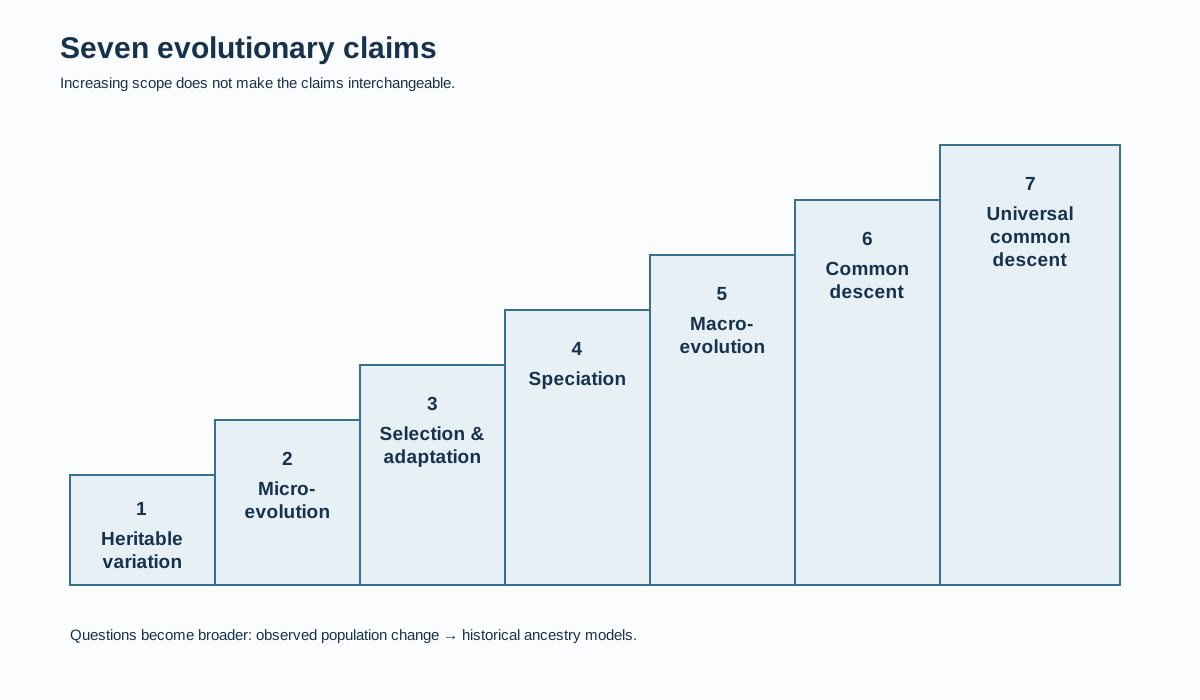
Foundations introduced the mechanisms and reasoning tools this chapter now puts to work. As the home page explained, “evolution” bundles at least seven distinct propositions of increasing scope, from something almost universally accepted to something considerably more inferential. This chapter treats each one on its own terms.
By the end of this chapter you should be able to:
- state each of the seven claims precisely, in isolation from the others;
- summarize the strongest evidence for and against each claim;
- explain what the evidence on each side does not establish; and
- describe what observation would seriously weaken or falsify each claim.
Every claim below follows the same nine-part pattern: Definition, Why It Matters, Strongest Evidence For, Strongest Challenge, What the Evidence For Does Not Prove, What the Challenge Does Not Prove, Falsification Test, Evidential Assessment, and Summary. Evidence for one claim does not automatically establish a broader claim above it — each level needs its own case.
1. Heritable Genetic Variation
Definition
Individuals differ genetically, new genetic variants arise, and at least some of those differences can be inherited. This is the basic raw material any theory of genetic evolution requires.
Why It Matters
Every other claim in this chapter depends on this one. Without heritable variation, there is nothing for natural selection to act on, nothing for populations to diverge by, and no raw material for any larger-scale change to accumulate from.
Strongest Evidence For
Modern sequencing allows heritable variation to be observed directly: sequence parents, sequence offspring, identify variants absent from the parents, and confirm that some of those new variants are inherited by later generations. A four-generation pedigree study using multiple sequencing technologies estimated roughly 98–206 new mutations of different types per transmission Four-generation pedigree mutation study. A large Icelandic study sequencing 1,548 parent-offspring trios identified more than 100,000 de novo mutations and demonstrated parental-age effects on mutation rate Icelandic de novo mutation study. This evidence is unusually strong because the variation is measured directly at the molecular level.
Strongest Challenge
There is essentially no serious evidence against the narrow claim that heritable genetic variation exists. The strongest qualification is that phenotypic variation is not equivalent to genetic variation: organisms with the same or similar genotypes can differ because of environment, developmental noise, epigenetic state, nutrition, and genotype-environment interaction. Experiments in Drosophila have shown substantial phenotypic variation even among individuals with the same genotype in a controlled environment Phenotypic variation in Drosophila.
What the Evidence For Does Not Prove
Observing mutation and inheritance does not establish that mutations can produce every conceivable biological innovation, that natural selection explains all evolutionary change, that one species can become another, that all organisms share common ancestry, or that life arose naturally from nonliving chemistry. It establishes only that heritable genetic variation exists.
What the Challenge Does Not Prove
Environmental influence on phenotype does not show that genes are unimportant, that genetic variation is absent, or that inheritance is not real. It shows that phenotype has more than one input.
Falsification Test
This claim would be seriously weakened by a systematic failure to detect new heritable variants in large, well-powered pedigree-sequencing studies, or by finding that apparent “new” variants consistently failed to be transmitted to further generations rather than being real, inherited differences. No such pattern has been observed.
Evidential Assessment
Directly observed. Extremely well established, and among the most directly measurable claims in this guide.
Summary
Heritable genetic variation is the foundation the rest of this chapter builds on. It is measured directly, not merely inferred, and no genuinely competing evidence exists against the narrow claim itself — only an important reminder that genotype is not the whole story of phenotype.
2. Microevolution
Definition
The genetic composition of a population can change across generations — for example, an allele present at 50% frequency in one generation reaching 80% frequency twenty generations later. By the population-genetic definition, this is evolution occurring.
Why It Matters
Microevolution is where heritable variation actually gets used: it is the process by which variation translates into a genuinely changed population over time, and it is the process most directly and repeatedly observed in real time, in the laboratory and in the field.
Strongest Evidence For
Richard Lenski's long-term E. coli evolution experiment tracked replicate populations, derived from a shared ancestor, across tens of thousands of generations; genome sequencing through 40,000 generations reconstructed much of this history Genome evolution in the long-term E. coli experiment. In that same experiment, one population evolved the ability to use citrate aerobically; genomic analysis traced the innovation to a tandem duplication that placed an existing citrate transporter gene under an aerobically active promoter, after earlier mutations had changed the genetic background in ways that made the innovation accessible Genomic basis of citrate utilization in E. coli. In a natural stream experiment, genetically mixed young sticklebacks released into the wild shifted, within a single generation, disproportionately toward stream-associated alleles at loci previously linked to stream adaptation Stickleback selection experiment.
Strongest Challenge
The strongest scientific challenge is not that microevolution fails to occur, but that evolutionary pathways are constrained. In already well-adapted E. coli backgrounds, beneficial mutations tend to provide progressively smaller fitness gains, a pattern called diminishing-returns epistasis Diminishing-returns epistasis. A separate antibiotic-resistance experiment found that particular genetic backgrounds sharply limited which evolutionary paths were accessible, producing apparent resistance ceilings under the tested conditions Resistance constraints and genetic background.
What the Evidence For Does Not Prove
The citrate experiment does not show that every complex structure evolves through the same regulatory-repurposing mechanism, that entirely novel systems always arise this way, or that thousands of laboratory generations directly establish millions of years of macroevolutionary change. The citrate transporter already existed; evolution changed its expression pattern and then refined the resulting system.
What the Challenge Does Not Prove
Demonstrated constraints show that evolution is limited and does not imply any organism can evolve any trait under any circumstances. They do not establish that a universal biological ceiling exists beyond which evolutionary change can never proceed anywhere. A limit observed in one organism, environment, or phenotype cannot automatically be generalized to all evolution.
Falsification Test
This claim would be seriously weakened if allele frequencies systematically failed to shift under sustained, measured selective pressure in controlled or field experiments that had adequate genetic variation and statistical power to detect a response — that is, if experiments like Lenski's or the stickleback field release reliably showed no response to selection at all, rather than the responses actually observed.
Evidential Assessment
Directly observed. The real, ongoing debate concerns the scope and long-term capacity of evolutionary mechanisms, not whether small-scale genetic change occurs.
Summary
Microevolution is directly observed, repeatedly, in both the laboratory and the field. Constraints on evolutionary pathways are real and well documented, but they establish limits in specific systems, not a universal ceiling on evolutionary change.
3. Natural Selection and Adaptation
Definition
If inherited differences affect reproductive success, variants that increase reproductive success in a particular environment can become more common over time. In evolutionary biology, fitness means approximately reproductive success in a particular environment, not strength or health in general.
Why It Matters
Natural selection is the mechanism Darwin proposed to explain adaptation — the apparent fit between organisms and their environments — without appeal to design. It is one of several evolutionary mechanisms, alongside drift, gene flow, and others, and its relative contribution has to be assessed case by case rather than assumed.
Strongest Evidence For
The strongest cases connect genotype to phenotype to differential survival or reproduction to a measurably changed allele frequency. In the stickleback field experiment, 77 of 126 candidate loci shifted toward stream-associated alleles after selection, significantly more than expected from neutral markers Stickleback selection experiment. Genomic work on Darwin's finches connected beak-size variation to a region containing the gene HMGA2 and showed allele-frequency changes tracking drought- and competition-driven selection Darwin's finches, HMGA2 and beak size.
Strongest Challenge
Natural selection does not explain every evolutionary change. Random genetic drift can shift allele frequencies with no fitness difference involved, and experimental work has directly observed drift producing genetic and phenotypic variation on its own Experimental neutral drift and phenotypic variation. Experiments in bacteria show that whether an allele spreads can depend on selection, pleiotropy, chance, and genetic background simultaneously Selection, pleiotropy and chance in bacterial evolution. Long-term study of Darwin's finches has also shown that the direction of selection itself can reverse as climate, food availability, and competition change Reversing selection in Darwin's finches.
What the Evidence For Does Not Prove
Observed natural selection does not by itself demonstrate that all complex structures arose by natural selection, that common descent is true, or that universal common ancestry is true. Natural selection is one mechanism; historical ancestry is a separate question addressed by claims 6 and 7 below.
What the Challenge Does Not Prove
This evidence refutes the overly strong claim that every biological feature exists because natural selection optimally designed it — a claim modern evolutionary biology itself does not make. It does not show that natural selection is not real or not demonstrated; it shows that drift, pleiotropy, chance, and changing selective regimes operate alongside it, and that organisms can carry neutral, maladaptive, or historically inherited traits as well as adaptive ones.
Falsification Test
This claim would be seriously weakened if genotype-linked fitness differences systematically failed to produce the predicted allele-frequency response across replicated field or experimental studies, or if traits tightly correlated with measured reproductive success repeatedly showed no detectable heritability at all.
Evidential Assessment
Directly observed. Natural selection is directly demonstrated as an adaptive mechanism; the relative contribution of selection versus drift and other mechanisms must be evaluated case by case.
Summary
Natural selection linking genotype to fitness to allele frequency is directly documented in field and laboratory studies. It coexists with drift, pleiotropy, and chance rather than operating as the sole cause of every trait, and it does not by itself settle questions of ancestry.
4. Speciation
Definition
Populations descended from a common ancestral population can diverge enough to become distinct, independently evolving, and/or reproductively isolated lineages. Species definitions themselves are complicated — the common “can interbreed and produce fertile offspring” concept becomes difficult to apply to bacteria, asexual organisms, extinct organisms, and lineages that occasionally hybridize — so some disagreements about whether speciation has “really” occurred in a given case are partly disagreements over definitions rather than over the underlying facts.
Why It Matters
Speciation is the process that turns ongoing microevolutionary change into the branching, tree-like pattern of distinct lineages that macroevolution and common descent both build on. Without some mechanism for lineages to become distinct, there would be no basis for the broader claims that follow.
Strongest Evidence For
Tragopogon mirus and T. miscellus formed as new allopolyploid plant species after their diploid parental species were introduced into western North America; genetic analysis indicates repeated, independent formation of these polyploid species within roughly the last century Tragopogon polyploid speciation. On the Galápagos island of Daphne Major, an immigrant Geospiza conirostris finch bred with a resident G. fortis; genetic pedigree work traced the descendants forming a persistent lineage that subsequently mated within itself and became reproductively isolated through morphology and mating behavior — the so-called “Big Bird” lineage Big Bird finch lineage.
Strongest Challenge
Species boundaries are often porous rather than absolute. Genomic research on Heliconius butterflies found a distinct lineage persisting despite ongoing gene flow that homogenizes roughly 99% of its genome with one parental lineage, with only a smaller portion of the genome retaining the traits involved in ecological and reproductive isolation Heliconius divergence with gene flow. Seven tropical eel species show extensive historical hybridization despite remaining distinguishable lineages over millions of years Historical hybridization among tropical eels.
What the Evidence For Does Not Prove
The easiest, most directly observed speciation cases tend to involve polyploidy, hybridization, strong ecological separation, or rapid reproductive mechanisms; they do not, by themselves, demonstrate how every historical species pair formed. Observed plant polyploid speciation, for instance, does not demonstrate the human-chimpanzee divergence process — each historical case still requires its own evidence.
What the Challenge Does Not Prove
Hybridization between named species does not show that speciation is unreal. It shows that the simplistic rule “different species can never exchange genes” is often incorrect, and that reproductive isolation is frequently a continuum — divergence, hybridization, introgression, renewed divergence — rather than always a clean, one-time binary split.
Falsification Test
This claim would be seriously weakened if reproductively or ecologically distinct lineages never arose in any observed or experimentally induced case of sustained divergence, or if every documented case of apparent speciation eventually turned out not to produce lasting reproductive or ecological distinctness at all.
Evidential Assessment
Directly observed in specific, documented cases (polyploid plant speciation, the Big Bird finch lineage). The general mechanisms and boundaries of species are often more complex, and more continuum-like, than simplified textbook diagrams suggest.
Summary
Speciation and lineage divergence are directly documented in multiple independent cases. Species boundaries are frequently porous rather than absolute, which complicates the picture without undermining the basic claim that lineages can become distinct.
5. Macroevolution
Definition
Over geological time, accumulated evolutionary change, speciation, extinction, developmental change, and other processes can produce large differences among descendant lineages — the kind of change proposed in transitions such as fish to early tetrapods, terrestrial mammals to whales, and non-avian dinosaurs to birds. No one can observe millions of years directly, so macroevolution is reconstructed historically rather than watched happening.
Why It Matters
Macroevolution is where the guide's evidence shifts from primarily direct observation toward primarily historical reconstruction. It is the claim that connects the directly observed mechanisms of claims 1–4 to deep evolutionary history, and it is where the strongest legitimate methodological questions about extrapolation and reconstruction reliability arise.
Strongest Evidence For
The strongest case comes from convergence of independent lines of evidence. Whale evolution is an unusually strong example: fossil ear structures document intermediate changes from terrestrial sound transmission toward the specialized hearing system of modern whales Cetacean hearing transition; the Eocene artiodactyl relative Indohyus combines whale-associated ear and tooth features, heavy limb bones, and isotope evidence consistent with aquatic habits Indohyus and early whale relatives; and independent molecular evidence from retroposon insertions places whales inside the artiodactyl radiation Retroposon evidence placing whales within artiodactyls. Paleontology, morphology, and molecular genetics converge on a compatible relationship. In the fish-to-tetrapod transition, Tiktaalik combines clear fish characteristics with a mobile neck, a modified skull, robust ribs, and fin bones with limb-like, wrist-like joints Tiktaalik transitional anatomy, making it a strong example of transitional anatomy — without necessarily being the exact direct ancestor of later tetrapods.
Strongest Challenge
The fossil record is incomplete: fossilization is rare, and evidence is lost to erosion, geological destruction, inaccessible strata, poor preservation of soft-bodied organisms, and incomplete sampling. Even researchers describing major transitional fossils acknowledge substantial remaining gaps Early tetrapod/transitional fossil analysis, so historical sequences typically consist of separated samples rather than an unbroken ancestor-to-descendant chain. Some radiations are also geologically rapid: one quantitative study estimated that early arthropod diversification during the Cambrian radiation involved morphological rates roughly four times, and molecular rates roughly 5.5 times, later background rates Cambrian evolutionary-rate analysis — evidence against an overly simplistic model in which evolutionary change must always proceed at a slow, uniform pace. The same analysis, however, concluded that the required rates remained within ranges compatible with evolutionary processes observed in living organisms.
What the Evidence For Does Not Prove
A transitional fossil does not automatically establish that it was the exact direct ancestor rather than a close relative, that every change along the way occurred by natural selection specifically, that the proposed phylogeny will never be revised, or that every other proposed macroevolutionary transition is therefore also proven.
What the Challenge Does Not Prove
Missing intermediates do not prove intermediates never existed. At the same time, scientists cannot use missing data to justify any imaginable evolutionary history: a proposed history still has to fit chronology, morphology, genetics, geography, and phylogenetic relationships together.
Falsification Test
Repeated discoveries of major organisms radically outside their predicted geological order would be seriously damaging — for example, a genuine, securely dated modern mammal fossil found in undisturbed Cambrian-age rock. That kind of chronological contradiction would be far more damaging than simply failing to find an expected intermediate fossil, which the incompleteness of the fossil record already predicts.
Evidential Assessment
Strongly supported by converging historical evidence. Its exact pathways, rates, and specific ancestors are more inferential than the directly observed mechanisms in claims 1–4.
Summary
Macroevolution's strongest support comes from independent lines of evidence — fossils, anatomy, molecular genetics, chronology — converging on compatible historical relationships, as in the whale and tetrapod transitions. Fossil incompleteness and rapid radiations are real complications, not proof against the claim, but they do mean this claim rests more on historical inference than on direct observation.
6. Common Descent
Definition
Different species descend from shared ancestral populations. This is broader than speciation but narrower than the claim that all cellular life shares one ancestor.
Why It Matters
Common descent is the historical-ancestry claim that ties individually documented speciation and macroevolutionary events together into a connected genealogical picture among well-studied groups, most thoroughly tested in humans and other great apes.
Strongest Evidence For
Simple similarity is weak evidence, since similar function can produce similar structure independently. Stronger evidence comes from nested, inherited historical features unlikely to be explained by function alone. Humans have one chromosome corresponding, end to end, to two separate chromosomes in other great apes; researchers identified internal head-to-head telomeric repeats at the expected fusion point, surrounded by sequences characteristic of chromosome ends Human chromosome 2 fusion site, and later work identified remnants of a second, degenerated ancestral centromere Degenerate ancestral centromere on human chromosome 2 — strong evidence for an ancestral chromosome-fusion event. Humans and other primates also share numerous endogenous retroviral insertions at corresponding genomic positions, with lineage-specific insertions following the expected primate branching pattern Primate endogenous retroviral insertion patterns, reasoning analogous to finding the same unusual copying error in the same location across multiple manuscript copies.
Strongest Challenge
Similarity does not necessarily mean ancestry, since convergent evolution can produce similar traits or even similar molecular solutions independently — which is why the nested-insertion evidence above, not simple resemblance, carries the real weight. Shared insertions can also occasionally be homoplastic (arise independently at the same site by chance); one primate study estimated insertion-site homoplasy at about 0.52%, though it found no independent LINE insertion events at the specific orthologous human-chimpanzee sites surveyed LINE insertion-site homoplasy in primates. And different genes can produce different trees: the gorilla genome revealed that while the dominant species relationship groups humans and chimpanzees together, roughly 30% of the genome locally groups gorilla with either humans or chimpanzees instead, a pattern generally explained by incomplete lineage sorting when population splits occur in relatively quick succession Gorilla genome and incomplete lineage sorting.
What the Evidence For Does Not Prove
Human chromosome 2 does not, by itself, prove whale evolution, the fish-to-tetrapod transition, universal common ancestry, or abiogenesis. Each broader claim needs its own supporting evidence.
What the Challenge Does Not Prove
Conflicting gene trees do not automatically falsify common descent; they falsify the overly simple assumption that every gene must share exactly the same branching history. Incomplete lineage sorting was not invented only to explain ape genomes — it follows from population-genetic models that generate quantitative, testable predictions about expected gene-tree discordance — but it does show that real ancestry can be considerably more complicated than a single, perfectly clean branching diagram.
Falsification Test
This claim would be seriously weakened by systematic, non-random contradictions between independent nested-similarity datasets — chromosome structure, endogenous retroviral insertions, and gene trees pointing to genuinely incompatible relationships that could not be explained by known complicating processes such as incomplete lineage sorting, hybridization, or convergence — rather than the occasional, statistically expected discordance actually observed.
Evidential Assessment
Very strongly supported within well-studied groups, especially by nested genomic evidence and chromosome-level historical signatures. Exact branching details in specific cases can remain uncertain.
Summary
Common descent among well-studied groups rests on nested, historically contingent genomic evidence — chromosome fusion signatures and shared retroviral insertions — that is considerably stronger than simple anatomical resemblance. Occasional gene-tree conflict is expected and explainable, not a wholesale contradiction of the claim.
7. Universal Common Descent
Definition
All presently known cellular organisms ultimately trace their genetic heritage to a common ancestral population, often associated with LUCA (the Last Universal Common Ancestor). LUCA does not necessarily mean the first life, a single individual cell, or the only origin of life that ever occurred.
Why It Matters
This is the broadest and most historically deep ancestry claim in the guide, extending the common-descent case from well-studied groups like humans and other apes to all of cellular life, including Bacteria, Archaea, and Eukarya. It is also the claim where the reconstruction becomes hardest and the open methodological questions are sharpest.
Strongest Evidence For
The strongest evidence is deep molecular similarity shared across all cellular life: DNA as hereditary material, RNA intermediates, ribosomes, a broadly shared genetic code, ATP-based energy chemistry, homologous proteins, and overlapping metabolic pathways. A comparative analysis of 23 conserved proteins across 45 organisms recovered a broad phylogenetic signal linking the three domains of life Conserved proteins across domains. Rather than simply assuming that sequence similarity implies ancestry, Douglas Theobald built explicit statistical models comparing universal common ancestry against separate-ancestry alternatives using universally conserved proteins; under the tested models, universal common ancestry was favored overwhelmingly Theobald statistical test of universal common ancestry.
Strongest Challenge
Theobald's statistical method itself was challenged: Yonezawa and Hasegawa argued the approach could favor common ancestry partly because aligned protein-coding sequences already contain correlations that need not originate from common ancestry, and demonstrated cases where apparently unrelated sequence families could still cause the method to prefer a common-origin model Critique of Theobald's universal-common-ancestry test. Theobald responded that the counterexample itself introduced correlations through how the coding sequences were aligned Theobald response to methodological critique, and a later independent methodological analysis concluded that an assumption-free formal proof of universal common ancestry had not been achieved, since some common-ancestry signal is already embedded in sequence similarity and alignment choices — while affirming that the broader comparative-genomic evidence for common ancestry remained very strong Analysis of formal tests of universal common ancestry. Separately, horizontal gene transfer means different genes can have different evolutionary histories; some researchers have argued that a strictly branching universal tree may describe only a small fraction of microbial genome histories, sometimes summarized as the “tree of one percent” Tree of one percent critique, and extensive lateral gene transfer in prokaryotic evolution is well documented Lateral gene transfer in prokaryotic evolution.
What the Evidence For Does Not Prove
Even if universal common descent is correct, it does not explain how life originated — it begins after heritable biological systems already exist and is not an origin-of-life theory. It does not establish whether life originated only once: life could theoretically have originated multiple times, and if all but one lineage went extinct, all currently known life could still share common ancestry, since universal common descent cannot easily detect extinct independent origins billions of years ago. It does not establish that LUCA was a single cell — LUCA may be better understood as a population, a genetic community, or a network of early cells exchanging genes — and it does not establish that every gene was vertically inherited from LUCA, since gene histories are complicated by horizontal transfer, duplication, loss, endosymbiosis, and recombination.
What the Challenge Does Not Prove
The methodological debate over Theobald's specific statistical test shows that a particular method may not constitute an assumption-free proof of universal common ancestry; it does not show that universal common ancestry has been disproven — criticizing a specific proof or methodology is different from disproving the underlying hypothesis. Similarly, horizontal gene transfer strongly challenges a simple model in which every gene in every organism follows the same clean branching tree, and early evolutionary history may have been considerably more network-like than that; it does not necessarily challenge shared ancestry itself, since a population of ancestral organisms could share descent, exchange genes extensively, and still produce different histories for different individual genes.
Falsification Test
This claim would be seriously weakened if the core molecular machinery shared across domains — the genetic code, ribosomal structure, core metabolic pathways — showed no defensible common-origin signal under rigorous model comparison, or if horizontal gene transfer turned out to be so pervasive that it affected essentially all genes, including the most deeply conserved core genes, leaving no meaningful vertical inheritance signal anywhere in the genome.
Evidential Assessment
Strongly supported, but increasingly difficult to reconstruct in detail. The deep molecular conservation and broad phylogenetic signal are strong; the earliest lineage structure and the precise nature of LUCA remain genuinely uncertain, and the formal statistical case for it has been methodologically contested without being overturned.
Summary
Universal common descent rests on deep, broadly shared molecular machinery across all three domains of life, reinforced by explicit statistical model comparison. Both the statistical method and the assumption of a single clean tree have been seriously challenged — challenges that sharpen and complicate the claim's earliest history without amounting to a demonstrated refutation of shared ancestry itself.
Key Takeaways
- The seven claims form a scale of increasing scope and increasing inferential distance, not seven restatements of the same idea.
- Claims 1–4 (heritable variation, microevolution, natural selection, and documented cases of speciation) are directly observed.
- Claim 5 (macroevolution) and claim 6 (common descent) are strongly to very strongly supported by converging historical and genomic evidence, but rest more on inference than on direct observation.
- Claim 7 (universal common descent) is strongly supported by deep molecular conservation, but its earliest history and the precise nature of LUCA remain genuinely more uncertain, and its strongest formal statistical test has been seriously, if not fatally, contested.
- Every claim's strongest challenge does real work — none of them is a straw man — but none of them, on inspection, disproves the claim it challenges.
Common Overstatements
- “Microevolution has been observed, so universal common ancestry is proven.” Each claim in this chapter needs its own evidence; strong support for claim 2 does not transfer automatically to claim 7.
- “Species boundaries are fuzzy, so speciation doesn't really happen.” Porous boundaries and hybridization show that reproductive isolation is often a continuum, not that lineages never become distinct — multiple cases of speciation are directly documented.
- “Gene-tree conflict disproves common descent.” Discordance between individual gene trees is an expected, quantitatively predicted consequence of population genetics (incomplete lineage sorting, hybridization, horizontal transfer); it does not amount to a systematic contradiction of shared ancestry.
- “A statistical test of universal common ancestry was criticized, so universal common ancestry has been disproven.” A methodological critique of one specific proof is not the same as evidence against the underlying claim; the broader comparative-genomic case remains strong even where one formal test has been contested.
Check Your Understanding
Why can't evidence for microevolution (claim 2) be used, by itself, to establish universal common descent (claim 7)?
Because the claims differ enormously in scope and in kind. Microevolution is a directly observed, short-timescale change in allele frequency within a population. Universal common descent is a claim about the deep ancestry of all cellular life, requiring its own evidence — conserved molecular machinery, formal statistical model comparison, and careful handling of complications like horizontal gene transfer. Demonstrating that a mechanism works does not, by itself, demonstrate everything that mechanism has ever been proposed to explain.
Does the existence of genetic drift undermine the evidence for natural selection?
No. Drift and selection are both real, independently documented mechanisms that can operate on the same population at the same time. Evidence for drift shows that not every change in allele frequency needs an adaptive explanation; it does not show that selection itself is not real or not demonstrated where the genotype-to-fitness link has actually been measured, as in the stickleback and Darwin's finch studies.
What would count as genuinely damaging evidence against macroevolution, as opposed to just an unexpected fossil gap?
A fossil gap is expected under any model of a real, incompletely sampled fossil record and is not, by itself, damaging. A genuine, securely dated fossil radically out of its predicted geological order — the guide's example is a modern mammal in undisturbed Cambrian-age rock — would be far more serious, because it would contradict the chronological ordering the framework predicts rather than merely leave a predicted intermediate temporarily or permanently unfound.
What We Know
Heritable genetic variation, microevolutionary change, natural selection acting on genotype-linked fitness differences, and specific documented cases of speciation are all directly observed. Macroevolution and common descent within well-studied groups are supported by strong, independently converging historical and genomic evidence. Universal common descent is supported by deep molecular conservation across all three domains of cellular life.
What Remains Disputed
How much extrapolation from short-term, small-scale experimental evolution to geological-scale macroevolutionary change is justified remains a genuine point of disagreement, taken up directly in Major Counterarguments. The precise branching history of the earliest cellular life, the nature of LUCA, and how much of the genome at that depth was vertically inherited versus horizontally exchanged are also unresolved in detail, even among researchers who accept universal common descent as the best-supported explanation available.
What Would Move the Debate Forward
For macroevolution and common descent: additional transitional fossils that fill currently acknowledged gaps, and continued cross-checking of independent data types (morphology, chronology, and multiple independent genomic signals) against one another, would either reinforce or meaningfully strain the current picture. For universal common descent specifically: statistical model-comparison methods that are demonstrably robust to the alignment-correlation critique raised against Theobald's original test, and a clearer quantitative accounting of how much of the deep genome is vertically versus horizontally inherited, would narrow one of the genuinely open questions identified above.
Sources for This Chapter
- [Primary Research] Four-generation pedigree mutation study
- [Primary Research] Icelandic de novo mutation study
- [Primary Research] Phenotypic variation in Drosophila
- [Primary Research] Genome evolution in the long-term E. coli experiment
- [Primary Research] Genomic basis of citrate utilization in E. coli
- [Primary Research] Stickleback selection experiment
- [Primary Research] Diminishing-returns epistasis
- [Primary Research] Resistance constraints and genetic background
- [Primary Research] Darwin's finches, HMGA2 and beak size
- [Primary Research] Experimental neutral drift and phenotypic variation
- [Primary Research] Selection, pleiotropy and chance in bacterial evolution
- [Primary Research] Reversing selection in Darwin's finches
- [Primary Research] Tragopogon polyploid speciation
- [Primary Research] Big Bird finch lineage
- [Primary Research] Heliconius divergence with gene flow
- [Primary Research] Historical hybridization among tropical eels
- [Primary Research] Cetacean hearing transition
- [Primary Research] Indohyus and early whale relatives
- [Primary Research] Retroposon evidence placing whales within artiodactyls
- [Primary Research] Tiktaalik transitional anatomy
- [Primary Research] Early tetrapod/transitional fossil analysis
- [Primary Research] Cambrian evolutionary-rate analysis
- [Primary Research] Human chromosome 2 fusion site
- [Primary Research] Degenerate ancestral centromere on human chromosome 2
- [Primary Research] Primate endogenous retroviral insertion patterns
- [Primary Research] LINE insertion-site homoplasy in primates
- [Primary Research] Gorilla genome and incomplete lineage sorting
- [Primary Research] Conserved proteins across domains
- [Methods / Conceptual] Theobald statistical test of universal common ancestry
- [Scholarly Critique / Response] Critique of Theobald's universal-common-ancestry test
- [Scholarly Critique / Response] Theobald response to methodological critique
- [Methods / Conceptual] Analysis of formal tests of universal common ancestry
- [Review / Synthesis] Tree of one percent critique
- [Primary Research] Lateral gene transfer in prokaryotic evolution